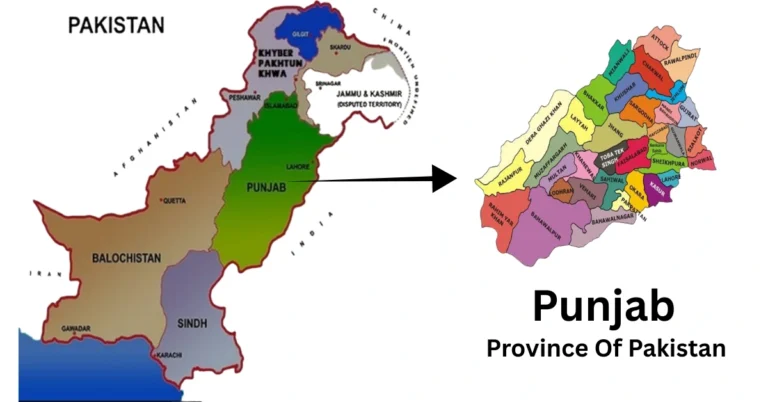
Punjab is Pakistan’s most populous province and one of the country’s most influential cultural, agricultural and economic regions. Located in eastern Pakistan, it is home to Lahore, the provincial capital and largest city, as well as major urban centers such as Faisalabad, Rawalpindi, Gujranwala and Multan.
According to Pakistan’s 2023 Population and Housing Census, Punjab has an official population of 127,688,922 people and covers 205,345 square kilometers. The province contains 52.87% of Pakistan’s population, making it the country’s largest province by population. As of 2026, the 2023 census remains the latest official population count.
Source: Pakistan Bureau of Statistics – Punjab Census Report 2023 | Pakistan Bureau of Statistics – National Census Report 2023
The name Punjab means the “land of five rivers,” a reference to the historic river system that shaped the region’s fertile plains, settlements and agricultural traditions. But Punjab is more than farmland. From Mughal monuments in Lahore and the ancient ruins of Harappa to the Salt Range, the Cholistan Desert, busy industrial cities and the Sufi heritage of Multan, the province brings together many different sides of Pakistan.
Punjab, Pakistan at a Glance
| Fact | Details |
|---|---|
| Country | Pakistan |
| Province | Punjab |
| Capital | Lahore |
| Largest city | Lahore |
| Official population | 127,688,922 – Census 2023 |
| Share of Pakistan population | 52.87% |
| Area | 205,345 km² |
| Population density | 621.83 people per km² |
| Urban population | 40.71% |
| 2017-2023 annual population growth | 2.53% |
| Main mother tongue | Punjabi |
| Other major languages | Saraiki, Urdu, Pashto and others |
| Major cities | Lahore, Faisalabad, Rawalpindi, Gujranwala, Multan, Sialkot, Sargodha and Bahawalpur |
Source: PBS Punjab Census Report 2023 | PBS National Census Report 2023
Where Is Punjab in Pakistan?
Punjab is located in the eastern part of Pakistan. It borders Khyber Pakhtunkhwa and Islamabad Capital Territory toward the north, Azad Jammu and Kashmir toward the northeast, Balochistan toward the west, Sindh toward the south and southwest, and India along its eastern boundary.
Its position has made Punjab a historic corridor for trade, migration and cultural exchange. Much of the province consists of fertile plains, but the landscape changes considerably across the region. The Potohar Plateau and Salt Range shape parts of northern Punjab, while Cholistan forms an arid belt in the southeast.
Source: Government of Punjab – Geography
Population of Punjab, Pakistan
The latest official population of Punjab is 127,688,922, recorded in Pakistan’s 2023 Population and Housing Census. Punjab had 109,989,655 people in the 2017 census, so the province added about 17.7 million residents between the two censuses. Its average annual population growth rate during 2017-2023 was 2.53%.
Punjab accounts for 52.87% of Pakistan’s total population. The census also records 51,975,967 people living in urban localities, equal to 40.71% of the provincial population, while the rest live in rural areas.
Source: Pakistan Bureau of Statistics – Punjab Census Report 2023 | Pakistan Bureau of Statistics – National Census Report 2023
What Is the Population of Punjab in 2026?
As of 2026, 127.69 million remains the latest official census population. Punjab’s population is likely higher today because the province continues to grow, but a 2026 figure would be a projection rather than a new official census count. For accuracy, the 2023 census remains the primary official population figure.
Area of Punjab, Pakistan
Punjab covers approximately 205,345 square kilometers, making it Pakistan’s second-largest province by land area after Balochistan. Despite being smaller in area than Balochistan, Punjab has a far larger population and a population density of about 621.8 people per square kilometer.
The combination of fertile plains, river-fed agriculture and a dense network of cities explains why settlement is much more concentrated here than in Pakistan’s more sparsely populated western regions.
Source: PBS National Census Report 2023
Major Cities of Punjab, Pakistan

Punjab contains many of Pakistan’s largest and most influential cities. Each has developed around a different mix of culture, industry, agriculture, trade, administration, education and religious heritage.
| City | Known for |
|---|---|
| Lahore | Provincial capital, Mughal heritage, culture, education, food and business |
| Faisalabad | Textiles, manufacturing and trade |
| Rawalpindi | Commerce, military significance and proximity to Islamabad |
| Gujranwala | Manufacturing, industry and food culture |
| Multan | Sufi shrines, handicrafts, mangoes and South Punjab heritage |
| Sialkot | Sports goods, surgical instruments and export industries |
| Bahawalpur | Palaces, Cholistan Desert and regional history |
| Sargodha | Citrus-growing region and agriculture |
| Jhelum | Historic landscape and access to Rohtas Fort and the Salt Range |
| Sheikhupura | Industry, agriculture and Mughal-era Hiran Minar |
Lahore
Lahore is the capital of Punjab and the province’s largest city. It is one of Pakistan’s major cultural, educational, commercial and historical centers. Mughal architecture, the Walled City, busy markets, food streets, universities and modern business districts all exist within the same urban landscape.
The Lahore Fort and Shalimar Gardens are jointly inscribed on UNESCO’s World Heritage List and are outstanding examples of Mughal artistic expression from the 16th and 17th centuries.
Source: UNESCO – Fort and Shalamar Gardens in Lahore
Faisalabad
Faisalabad is one of Punjab’s largest industrial centers and is especially associated with textiles and manufacturing. Its historic Clock Tower sits at the center of a distinctive network of bazaars, while industrial districts extend far beyond the older commercial core.
Rawalpindi
Rawalpindi sits beside Islamabad and forms part of the closely connected twin-city region. Its identity combines older markets such as Raja Bazaar with trade, transport, military institutions and rapid urban development.
Multan
Multan is one of South Punjab’s most historically important cities. Often known as the “City of Saints,” it is famous for Sufi shrines, traditional blue pottery, bazaars and mango-growing areas. Its spiritual and artistic traditions give it an identity distinct from the industrial centers of central Punjab.
Sialkot
Sialkot has developed an international reputation for export-oriented manufacturing, especially sports goods and surgical instruments. Its industrial clusters connect Punjab directly with global supply chains while retaining the character of an old Punjabi city.
Geography of Punjab

Punjab’s geography is defined by water, fertile plains and strong regional contrasts. While much of the province is flat and intensively cultivated, northern Punjab includes plateaus and hills, and parts of southern Punjab transition into arid desert landscapes.
Plains and Agricultural Land
Central Punjab contains vast alluvial plains formed by river systems over thousands of years. Irrigation canals and fertile soils support crops such as wheat, rice, sugarcane and cotton. This agricultural landscape has shaped Punjab’s villages, economy and settlement patterns for generations.
Potohar Plateau and Salt Range
Northern Punjab is geographically different from the flatter central plains. The Potohar Plateau contains rolling terrain, ravines and rain-fed agricultural areas, while the nearby Salt Range is known for mineral resources, geological formations and historic sites. For a broader view of these landforms, see Nature Explorer’s guide to Pakistan’s mountain ranges.
Cholistan and Thal Deserts
Southern Punjab becomes considerably drier. The Cholistan Desert, near Bahawalpur, is known for sand dunes, desert settlements, Derawar Fort and the Cholistan Jeep Rally. The Thal Desert forms another semi-arid zone across western and central parts of the province.
Travelers interested in desert driving and rally-style routes can also explore Nature Explorer’s off-road and Jeep safari guide.
Rivers of Punjab
Water has shaped Punjab’s name, agriculture and settlement. The Government of Punjab identifies the Indus, Jhelum, Chenab, Ravi and Sutlej among the major rivers flowing through the province. These waters feed irrigation systems, support farming communities and have historically influenced where towns and cities developed. For wider context, see Nature Explorer’s guide to the rivers of Pakistan.
Source: Government of Punjab – Geography
Why Is Punjab Called the Land of Five Rivers?
The word Punjab comes from Persian roots meaning “five waters.” Historically, the five rivers associated with the wider Punjab region are the Jhelum, Chenab, Ravi, Sutlej and Beas.
There is an important modern geographical distinction: the historic Punjab region is now divided between Pakistan and India. The Beas flows in Indian Punjab rather than through Pakistan’s Punjab Province. This is why modern maps of Pakistani Punjab also prominently show the Indus, even though the Indus is not one of the five rivers that gave the historic region its name.
Source: Pakistan Bureau of Statistics – Punjab Census Report 2023 | Nature Explorer – Rivers of Pakistan
Is Punjab in Pakistan or India?
Punjab exists on both sides of the Pakistan-India border. Pakistan has a province officially called Punjab, with Lahore as its capital. India also has a state called Punjab, with Chandigarh serving as its capital.
Before the Partition of British India in 1947, these areas formed part of a much larger historical Punjab region. Partition divided that region between the newly created Pakistan and India. When someone searches for “Punjab, Pakistan,” they are referring specifically to the Pakistani province covered in this guide.
History of Punjab
Punjab’s history stretches back thousands of years and reflects many of the civilizations and empires that shaped South Asia.
The Indus Valley Civilization
One of Punjab’s earliest major urban centers was Harappa, near present-day Sahiwal. It formed part of the Indus Valley Civilization, one of the world’s earliest large urban civilizations. Archaeological remains reveal planned streets, drainage systems, craft production and long-distance trade.
Punjab Under the Mughals
Punjab became especially important during the Mughal period. Lahore developed into an imperial and cultural center, leaving behind architecture that remains central to the city’s identity. Lahore Fort, Shalimar Gardens, Badshahi Mosque and other surviving structures demonstrate the artistic ambition of this era.
Source: UNESCO – Fort and Shalamar Gardens in Lahore
Sikh Rule
In the late 18th and early 19th centuries, Lahore emerged as the capital of the Sikh Empire under Maharaja Ranjit Singh. Punjab remains deeply important to Sikh history. Nankana Sahib is associated with the birth of Guru Nanak, while Kartarpur is one of Sikhism’s most significant pilgrimage destinations.
British Period
British control of Punjab began in the 19th century and brought major administrative, educational, railway and irrigation developments alongside colonial rule. Cities such as Lahore became important centers of education and political activity, while canal-colony development reshaped agricultural settlement across parts of the province.
Partition of 1947
Punjab was at the center of the Partition of British India in 1947. The division of the historic province between Pakistan and India triggered huge population movements, communal violence and lasting social change. Millions of Muslims, Sikhs and Hindus crossed the new border, transforming cities, villages and families across both sides of Punjab.
Languages, People and Culture of Punjab
Punjabi culture is strongly associated with hospitality, family life, music, poetry, agriculture, crafts and communal celebrations, but the province is linguistically and culturally more diverse than its name alone suggests.
According to the 2023 Census, Punjabi was the mother tongue of 67.00% of Punjab’s population, Saraiki 20.64%, and Urdu 7.18%. Other reported languages include Pashto, Balochi, Hindko, Mewati, Kashmiri and others.
Source: Pakistan Bureau of Statistics – Punjab Census Report 2023
Punjabi itself has many regional accents and varieties. Saraiki is especially important across southern Punjab, while Urdu is widely understood and commonly used in education, media, government and communication between people with different mother tongues. English also has a strong presence in higher education and professional settings.
Punjab’s traditional culture can be seen in folk music, bhangra, luddi, qawwali, poetry, village fairs and handicrafts. Phulkari embroidery, Multani blue pottery and carved Chinioti woodwork are among the crafts associated with different parts of the province. Cricket is enormously popular, while traditional sports such as kabaddi and wrestling remain closely connected with rural Punjabi culture.
Food of Punjab

Food is one of the easiest ways to experience Punjabi culture. Traditional meals tend to be hearty, communal and strongly connected to seasonal ingredients. Fresh roti, lentils, vegetables, yogurt and pickles remain everyday staples across many households.
Winter brings one of Punjab’s most recognizable combinations: sarson da saag with makki di roti. Other popular dishes found across the province include karahi, nihari, haleem and siri paye, although recipes and eating habits vary from city to city.
Street food has an equally important place in urban life. Samosas, chaat, golgappay, kebabs and fried snacks fill markets and food streets, particularly in cities such as Lahore and Rawalpindi. Punjabi sweets include jalebi, gulab jamun, barfi and gajar ka halwa, while lassi remains one of the region’s most recognizable traditional drinks.
Festivals and Traditions in Punjab
Punjab’s celebrations reflect religion, agriculture, Sufi traditions and regional culture. Eid al-Fitr and Eid al-Adha are major religious occasions marked by prayers, family gatherings, food and charity. Urs festivals at Sufi shrines bring together pilgrimage, poetry, qawwali and communal meals.
Baisakhi has deep connections with Punjab’s agricultural cycle and Sikh heritage, while other local fairs and shrine festivals continue across different districts. Basant has a particularly strong historical association with Lahore and kite flying. Because regulations around kite flying and public Basant celebrations can change, it is better to describe Basant as part of Punjab’s cultural heritage and advise travelers to check current rules before planning around a kite-flying event.
Economy of Punjab
Punjab plays a central role in Pakistan’s economy because of the scale of its agriculture, manufacturing, services, trade and population.
Agriculture remains fundamental. The province’s irrigated plains produce wheat, rice, cotton, sugarcane, fruits and other crops, while livestock and related industries support millions of rural households. Manufacturing is concentrated in several major urban areas: Faisalabad is strongly associated with textiles, Sialkot with sports goods and surgical instruments, and Gujranwala with manufacturing and engineering.
Lahore has a more diversified economy, combining manufacturing and trade with finance, technology, education, media, retail and professional services. Rather than attaching a single provincial GDP percentage that can vary by source and year, this updated guide focuses on the sectors that explain Punjab’s economic importance.
Education in Punjab

Punjab contains some of Pakistan’s largest networks of schools, colleges and universities. According to the Pakistan Economic Survey 2025-26, the literacy rate for people aged 10 and above in Punjab reached 68% in 2024-25, up from 66% in 2022-23. The same survey reports 61% literacy in rural Punjab and 78% in urban Punjab for 2024-25.
Source: Pakistan Economic Survey 2025-26 – Education
Lahore is home to major institutions including the University of the Punjab, Government College University, Lahore University of Management Sciences, King Edward Medical University and the University of Engineering and Technology. Other important universities are spread across Faisalabad, Multan, Rawalpindi and other cities.
Best Places to Visit in Punjab, Pakistan

Punjab offers a strong mix of history, religious heritage, cities, deserts and cultural experiences.
| Place | Why visit |
|---|---|
| Lahore Fort | Mughal architecture and UNESCO World Heritage |
| Shalimar Gardens | Historic Mughal gardens and UNESCO World Heritage |
| Badshahi Mosque | One of Lahore’s most recognizable Mughal landmarks |
| Walled City of Lahore | Historic gates, bazaars, architecture and food |
| Harappa | Archaeological remains of the Indus Valley Civilization |
| Rohtas Fort | 16th-century military fort and UNESCO World Heritage Site |
| Khewra Salt Mine | Salt Range landscape and underground visitor areas |
| Multan | Sufi shrines, bazaars, handicrafts and historic architecture |
| Derawar Fort | Monumental desert fort in Cholistan |
| Noor Mahal | Royal-era palace in Bahawalpur |
| Hiran Minar | Mughal-era monument and water complex near Sheikhupura |
| Cholistan Desert | Desert scenery, culture and Jeep Rally |
| Murree | Hill scenery, forests, cool summers and winter weather |
| Kartarpur | Major Sikh pilgrimage destination |
Lahore Fort and Shalimar Gardens
These are among Punjab’s most important historic landmarks and are jointly recognized by UNESCO. For a deeper city-level itinerary, explore Nature Explorer’s complete Lahore guide.
Source: UNESCO – Fort and Shalamar Gardens in Lahore
Rohtas Fort
Located near Jhelum, Rohtas Fort was begun under Sher Shah Suri in the 16th century. UNESCO describes the roughly 70-hectare complex as an exceptional example of early Muslim military architecture in Central and South Asia.
Source: UNESCO – Rohtas Fort
Harappa
Harappa offers one of Punjab’s strongest connections to the ancient past. Its archaeological remains help visitors understand the planning, craft production and urban organization of the Indus Valley Civilization.
Khewra Salt Mine
Located within the Salt Range, Khewra is famous for extensive underground salt deposits and has become one of Punjab’s most distinctive geological tourism destinations.
Cholistan and Derawar Fort
The Cholistan Desert provides a completely different experience from Punjab’s green agricultural plains. Derawar Fort, with its enormous bastions rising from the desert, has become the visual symbol of the region. Nature Explorer’s off-road and Jeep safari guide is useful for travelers interested in rugged routes and rally-style terrain.
Multan
Multan rewards travelers interested in religious architecture, Sufi history, old bazaars and crafts rather than monumental Mughal sites alone. The shrines of Shah Rukn-e-Alam and Bahauddin Zakariya are among its best-known landmarks.
Murree
Murree offers pine-covered hills, cooler summers, winter snowfall and easy access from Islamabad and Rawalpindi. It gives the Punjab guide a useful counterpoint to the province’s plains and deserts, showing how varied the province becomes toward its northern edge.

Punjab: More Than the “Heart of Pakistan”
Calling Punjab the “Heart of Pakistan” reflects its population, culture, agriculture and historic influence, but the phrase only begins to explain the province. Punjab contains ancient archaeological sites and some of Pakistan’s largest modern cities. Its landscapes move from fertile river plains to salt hills, forests and deserts. Punjabi, Saraiki and Urdu coexist across different communities, while food, music, Sufi traditions, crafts and festivals give different regions their own identities.
For travelers, Punjab can mean exploring Lahore’s Mughal monuments, walking through the ruins of Harappa, seeing the walls of Rohtas Fort, traveling into Cholistan, visiting shrines in Multan or escaping to Murree. Its diversity is precisely what makes Punjab difficult to define through a single landmark or statistic.
To continue exploring the country beyond Punjab, visit Nature Explorer’s complete Pakistan travel and geography guide or browse the latest articles in the Punjab section.
Frequently Asked Questions About Punjab, Pakistan
What is Punjab in Pakistan?
Punjab is one of Pakistan’s four provinces. It is located in eastern Pakistan and is the country’s largest province by population. Lahore is its capital.
Is Punjab a province of Pakistan?
Yes. Punjab is an official province of Pakistan. There is also a separate Indian state called Punjab because the historic Punjab region was divided between Pakistan and India during Partition in 1947.
Where is Punjab located in Pakistan?
Punjab lies in eastern Pakistan. It borders Khyber Pakhtunkhwa and Islamabad toward the north, Azad Jammu and Kashmir toward the northeast, Balochistan toward the west, Sindh toward the south and India toward the east.
What is the population of Punjab, Pakistan?
Punjab’s latest official population is 127,688,922, according to Pakistan’s 2023 Population and Housing Census. As of 2026, this remains the latest official census count.
What is the area of Punjab, Pakistan?
Punjab covers approximately 205,345 square kilometers and is Pakistan’s second-largest province by land area after Balochistan.
What is the capital of Punjab, Pakistan?
Lahore is the capital of Punjab and its largest city.
What are the major cities of Punjab?
Major cities include Lahore, Faisalabad, Rawalpindi, Gujranwala, Multan, Sialkot, Sargodha, Bahawalpur, Jhelum and Sheikhupura.
What language is spoken in Punjab, Pakistan?
Punjabi is the largest mother-tongue group in the province. The 2023 Census reports Punjabi at 67.00%, Saraiki at 20.64% and Urdu at 7.18%, with several other languages also spoken.
Why is Punjab called the Land of Five Rivers?
The name Punjab comes from words meaning “five waters.” The historic five rivers are the Jhelum, Chenab, Ravi, Sutlej and Beas. Today the Beas flows in Indian Punjab rather than Pakistan’s Punjab Province.
What is Punjab famous for?
Punjab is known for fertile agricultural plains, Punjabi and Saraiki culture, Lahore’s Mughal heritage, Sufi shrines, traditional food, textiles, sports-goods manufacturing, historic sites and major cities.
What are the best places to visit in Punjab?
Popular places include Lahore Fort, Shalimar Gardens, Badshahi Mosque, the Walled City of Lahore, Harappa, Rohtas Fort, Khewra Salt Mine, Multan, Derawar Fort, Noor Mahal, Cholistan Desert and Murree.

4 thoughts on “Discover Punjab: The Heart of Pakistan”
Exzellenter Blog, den du hier hast.. Es ist schwer, so gute
Schreibweise heutzutage zu finden. Ich respektiere wirklich Leute wie dich.
Mach weiter so!!
My family members every time say that I am killing my time here at
web, however I know I am getting familiarity all the time by reading such good articles or reviews.
Highly descriptive article, I liked that a lot. Will there be a
part 2?
Beautiful