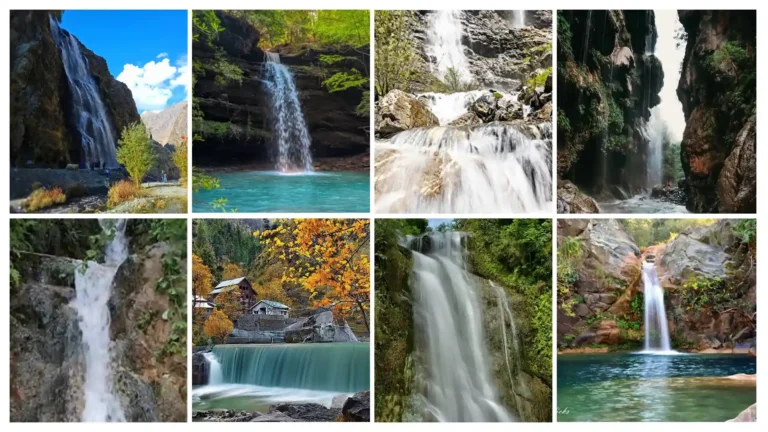
A waterfall in Pakistan rarely appears on its own.
In the north, water may fall from a dark mountain wall beside a river fed by snow and glaciers. In Swat, the journey can lead through forest before a cascade appears between steep green slopes. Around Abbottabad, reaching the water may involve leaving the road and descending into the hills. Farther south, a waterfall can emerge inside a dry canyon where almost nothing in the surrounding landscape suggests that flowing water is nearby.
That variety is what makes the waterfalls of Pakistan worth exploring as a landscape of their own.
Some are easy stops during a larger road trip. Others turn the walk toward the water into part of the experience. Some flow strongly through the warmer months, while smaller seasonal cascades depend much more on rain.
This guide brings those different landscapes together, helping you understand where Pakistan’s waterfalls are found, how they differ by region, which ones suit different kinds of trips, and where to explore next.
Waterfalls of Pakistan at a Glance
| Region | Typical Landscape | Good For | Character |
|---|---|---|---|
| Gilgit-Baltistan | High mountains, exposed rock, snow-fed and glacial streams | Scenic drives, photography and mountain journeys | Open, dramatic and rugged |
| Khyber Pakhtunkhwa | Forested valleys, cliffs and mountain streams | Hiking, day trips, families and road journeys | One of Pakistan’s most varied waterfall regions |
| Azad Jammu & Kashmir | Steep green valleys, rivers and forested slopes | Road trips, photography and valley exploration | Water-rich and densely green |
| Punjab | Potohar hills, northern uplands and seasonal streams | Short escapes and day trips | Smaller and often more accessible |
| Sindh | Dry hills, rocky channels and seasonal water | Exploration after suitable rainfall | Rare and strongly seasonal |
| Balochistan | Canyons, springs, ravines and dry mountains | Remote travel and wilderness journeys | Water contrasted against arid terrain |
The important point is that there is no single Pakistan waterfall experience.
A traveler standing below Manthokha Waterfall in Kharmang is looking at a completely different landscape from someone walking toward Jarogo in Swat or entering the canyon system of Moola Chotok in Balochistan.
Which Waterfall Experience Is Right for You?
Not every journey needs to begin with the question, “Which waterfall is the biggest?”
A more useful question is: what kind of experience are you looking for?
| If You Want… | A Good Place to Start |
|---|---|
| A dramatic mountain waterfall | Manthokha Waterfall |
| A short but active waterfall visit | Umbrella Waterfall |
| Forest and waterfall together | Jarogo Waterfall |
| A waterfall close to a Swat city base | Shingrai Waterfall |
| An arid canyon shaped by flowing water | Moola Chotok |
| A waterfall as part of a Neelum Valley journey | Kutton and other Lower Neelum stops |
| A mountain journey where waterfalls are part of the trek | Upper Dir and other high-valley routes |
| A shorter escape from Islamabad or Rawalpindi | Potohar and Abbottabad-side waterfall areas |
These are starting points rather than rankings. Water level, season, road conditions and the type of access required can change the experience completely.
Best Waterfall Hikes in Pakistan
Search for the best waterfall hikes in Pakistan and one distinction quickly becomes important: not every waterfall visit is really a hike.
Some waterfalls require a meaningful walk through forest or mountain terrain. Others are reached largely by road with only a short descent or walk near the site.
Knowing the difference makes it easier to choose a waterfall that matches the kind of trip you want.
| Waterfall / Area | Region | Type of Experience | General Effort |
|---|---|---|---|
| Umbrella Waterfall | Abbottabad, KP | Hill approach followed by a descent toward the cascade | Short but active |
| Jarogo Waterfall | Swat, KP | Forest and mountain approach | Moderate |
| Shingrai Waterfall | Swat, KP | Village-side approach into a steep waterfall setting | Short to moderate |
| Upper Dir waterfall areas | Upper Dir, KP | Waterfalls connected to larger meadow and mountain journeys | Trek-based |
| Selected Nagar waterfalls | Gilgit-Baltistan | Mountain walking within glacier and valley landscapes | Varies |
| Neelum side-valley waterfalls | AJK | Waterfall stops combined with valley exploration | Varies |
Not Every Famous Waterfall Is a Trek
Manthokha Waterfall is a good example.
It is primarily a road-access destination rather than a long waterfall hike. The journey through Kharmang is part of the experience, but visitors can travel close to the waterfall by vehicle and explore the area on foot.
The Gilgit-Baltistan Tourism Department identifies Manthokha as an accessible attraction in Kharmang and lists it at approximately 180 feet high.
For broader trekking inspiration beyond waterfalls, explore our guide to hiking in Pakistan.
When Do Pakistan’s Waterfalls Have the Best Flow?
Waterfall season is not the same everywhere in Pakistan.
The source of the water matters.
A cascade fed by high mountain snow behaves differently from a small waterfall created by monsoon runoff. That means there is no single month that guarantees the best conditions across the entire country.
| Landscape | Typical Pattern | What Travelers Should Expect |
|---|---|---|
| High northern mountains | Warmer months increase snow and ice melt | Stronger streams but changing mountain conditions |
| Forested northern valleys | Spring, summer and rainfall influence flow | Green surroundings and active streams |
| Monsoon-fed hills | Rain can transform smaller cascades quickly | Stronger water but greater flash-flood risk |
| Dry southern landscapes | Some sites rely more heavily on rainfall or springs | Conditions may change dramatically between visits |
| Winter mountain areas | Cold, snow and ice can reduce accessibility | Road conditions become as important as waterfall flow |
More water does not automatically mean a better visit. Heavy rain can make a waterfall more dramatic while making stream crossings, wet rocks, ravines and approach routes considerably more dangerous.
Waterfalls of Gilgit-Baltistan

In Gilgit-Baltistan, waterfalls belong to a much larger system of mountains, glaciers, rivers and steep valleys.
Water often feels inseparable from the terrain around it. A cascade may descend from an exposed cliff, follow a snow-fed stream or appear beside a road already surrounded by some of Pakistan’s largest mountain landscapes.
Manthokha Waterfall — Kharmang
Manthokha stands out because of contrast.
White water drops against the rocky walls of Kharmang while greener ground gathers around the stream below. The official tourism department places the waterfall in Kharmang District and gives an approximate height of 180 feet.
It works particularly well as part of a wider journey from Skardu into Kharmang rather than as an isolated attraction.
Continue exploring: our detailed Manthokha Waterfall guide.
Khamosh Waterfall — Kharmang
Khamosh Waterfall adds another quieter waterfall setting to Kharmang, where flowing water creates a striking contrast with the surrounding mountain terrain.
Waterfalls Beyond Kharmang
Smaller and locally known waterfalls also appear across Nagar, Astore, Ghizer, Naltar and other northern valleys.
Some are destinations in their own right. Others are best experienced as part of a glacier, valley or village journey.
Waterfalls of Khyber Pakhtunkhwa

Khyber Pakhtunkhwa contains some of the most varied waterfall environments in Pakistan.
Abbottabad brings waterfalls into green hill country. Swat combines cascades with forest and steep valleys. Upper Dir connects moving water with larger trekking and meadow landscapes.
Sajikot Waterfall — Abbottabad
Sajikot is one of the better-known waterfall sites in the Abbottabad hills.
Its rocky setting and natural pool make it visually striking, but this is also a place where beauty should not be confused with safe swimming conditions.
Past incidents at Sajikot have involved drownings, which is why the water deserves caution rather than casual assumptions based on photographs.
Umbrella Waterfall — Abbottabad
Umbrella Waterfall is visually different from a single vertical cascade.
Water spreads across a vegetation-covered rock face and separates into smaller streams, giving the waterfall its curtain-like appearance.
The waterfall belongs to the Poona-Sajikot side of Abbottabad District and is best treated as a short active nature excursion rather than simply a roadside photo stop.
Continue exploring: our Umbrella Waterfall travel guide.
Jarogo Waterfall — Swat
Jarogo belongs to the forested side of Swat.
The journey toward it moves through mountain terrain and pine-covered surroundings, making the approach part of the experience rather than background scenery.
Published descriptions of Jarogo’s exact height vary considerably. What is better established is the landscape: a major waterfall surrounded by steep mountains and forest.
Shingrai Waterfall — Swat
Shingrai offers a different Swat experience.
It sits within practical reach of the Mingora side of the valley, but the waterfall itself feels enclosed by steep slopes, rock and vegetation.
Its appeal lies in the compact natural setting created where the cascade meets the pool below.
Continue exploring: our Shingrai Waterfall guide.
Other Waterfalls of KP
- Kiwai and other Kaghan-side cascades
- Noori Waterfall
- Upper Dir waterfall areas
- Matiltan and upper Swat cascades
- Smaller seasonal waterfalls across Hazara and Swat
If your route continues through the Kaghan side of the province, our Naran-Kaghan Valley guide gives the wider landscape context.
Waterfalls of Azad Jammu & Kashmir

Azad Jammu & Kashmir is shaped by steep valleys, rivers, forest and tributary streams.
Here, waterfalls often feel like part of the road itself. Water crosses the landscape repeatedly as travelers move from Muzaffarabad deeper toward Neelum Valley.
Dhani Waterfall
Dhani is one of the recognizable waterfall stops associated with the Neelum route.
Rather than requiring a separate expedition, it fits naturally into a longer journey through the valley.
Kutton Waterfall — Neelum Valley
Kutton is closely connected to the Kundal Shahi and Jagran side of Neelum Valley.
The waterfall belongs within a wider landscape of streams, settlements and forested valley slopes.
For the wider destination, continue to our Neelum Valley travel guide.
Beyond the Main Road
More cascades appear around side valleys and upper mountain routes throughout AJK, where water remains a constant part of the wider valley landscape.
Waterfalls of Punjab

Punjab is not usually the first region people associate with waterfalls.
That makes its smaller cascades interesting for a different reason.
Rather than high alpine drops, much of the waterfall landscape is associated with Potohar, northern hill country, forest areas and streams whose appearance can change significantly with rainfall.
Neela Sandh
Neela Sandh is one of the better-known natural water escapes in Rawalpindi District.
It makes more sense as a short nature trip from the Islamabad-Rawalpindi region than as a northern-style mountain expedition.
Kanhatti and the Salt Range Landscape
In places such as Kanhatti, the experience is wider than a single cascade.
Forest, trails, springs and seasonal water all contribute to the trip.
Smaller Punjab waterfalls offer a different experience from the mountain cascades of Gilgit-Baltistan and Swat, with easier access often becoming part of their appeal.
Waterfalls of Sindh

Sindh tells a more seasonal waterfall story.
Across its dry and rocky landscapes, rainfall can temporarily change channels, ravines and hill slopes that remain almost dry for much of the year.
That means the most important factor is often not a permanent waterfall name but timing.
Seasonal Cascades and Rocky Landscapes
After suitable rainfall, parts of Sindh’s hill country can produce small cascades and active channels that look completely different from their dry-season appearance.
Because many of these water features are seasonal, conditions can change considerably between one visit and the next.
Waterfalls of Balochistan

Balochistan may offer the strongest contrast of all.
Much of the province is defined by exposed rock, dry valleys and vast distances.
Then water appears inside a canyon or between mountain walls and changes the character of the landscape almost immediately.
Moola Chotok — Khuzdar
Moola Chotok is better understood as a canyon-and-waterfall environment than as one simple vertical drop.
Water moves through the ravine, forming cascades and pools while vegetation follows the wetter ground between otherwise dry mountain walls.
The Government of Balochistan lists Moola Chotok among the province’s natural attractions and identifies it with Khuzdar.
Continue exploring: our complete Moola Chotok Waterfalls guide.
Pir Ghaib — Bolan
Pir Ghaib adds another type of waterfall landscape to Balochistan.
Here, water, rocky terrain and local cultural associations come together in a setting very different from Pakistan’s forested northern waterfalls.
Which Is the Tallest Waterfall in Pakistan?
This sounds like a simple question.
It is not.
There is no widely available national survey that gives standardized measurements for every major waterfall in Pakistan.
Online sources frequently give different numbers for the same places, and some measurements appear to compare total cascading distance, cliff height and a single vertical drop as if they were the same thing.
What Can Be Said Reliably?
- The Government of Gilgit-Baltistan lists Manthokha Waterfall at approximately 180 feet / 55 metres.
- Jarogo is widely described as a major Swat waterfall, but published height descriptions vary.
- Several other waterfalls are described as among Pakistan’s highest, but reliable standardized measurements remain limited.
For travelers, height is only one part of the experience. Setting, access, water flow and the surrounding landscape often matter just as much.
How to Choose a Waterfall Trip in Pakistan
For Families
Look for destinations where most of the journey can be completed by road and the remaining walking is manageable for the group.
- Manthokha Waterfall
- Selected Neelum roadside stops
- Some Abbottabad-area waterfall excursions
- Shorter Potohar nature trips
Family-friendly should never be interpreted as risk-free. Children still need close supervision around natural pools, wet rocks and fast water.
For Hikers
Choose places where the walk genuinely contributes to the experience.
- Jarogo and other forested Swat waterfalls
- Umbrella Waterfall
- Waterfall areas connected to Upper Dir mountain routes
- Selected side-valley waterfalls in AJK and Gilgit-Baltistan
For Photography
Think beyond waterfall height.
Often the stronger image is created by contrast:
- White water against Kharmang’s exposed mountain walls
- Forest surrounding a Swat waterfall
- The enclosed pool below Shingrai
- The textured rock face at Umbrella
- Green water and vegetation inside the dry canyon of Moola Chotok
The landscape around a waterfall often tells more of the story than the falling water alone.
For Road Trips
A waterfall is often most enjoyable when it already belongs to your route.
- Manthokha during a Kharmang journey
- Kiwai while exploring the wider Naran-Kaghan landscape
- Dhani or Kutton during a Neelum Valley trip
- Shingrai while based around Mingora and lower Swat
That usually creates a better journey than trying to fit several distant waterfalls into one rushed itinerary.
Waterfall Safety in Pakistan
Falling water makes a place look inviting.
It does not make it safe.
Natural pools can become deep without warning. Rocks near the base of a waterfall can be extremely slippery, and water levels can change quickly after heavy rain.
Pakistan’s National Disaster Management Authority regularly warns that heavy rainfall can rapidly increase flows in rivers, streams and hill torrents, particularly in mountainous and monsoon-affected regions.
Before visiting a waterfall:
- Check recent weather and road conditions.
- Avoid narrow ravines and stream crossings during or immediately after heavy rain.
- Do not assume a calm-looking natural pool is safe for swimming.
- Stay back from strong water and slippery cliff edges.
- Keep children under close supervision.
- Wear footwear suitable for wet rock and uneven ground.
- Allow enough daylight for the return journey.
- Respect barriers, closures and instructions from local authorities.
- Never cross a flooded road or fast-moving stream simply because another vehicle has done it.
For current warnings during unstable weather, check the National Disaster Management Authority advisories before traveling.
Responsible Waterfall Travel
Waterfalls can be damaged surprisingly quickly.
A small pool surrounded by rock has nowhere to hide plastic bottles, snack wrappers, disposable plates or broken glass. At heavily visited locations, even a few careless groups can change the character of the site.
A better approach is simple:
- Carry your rubbish back with you.
- Avoid using soaps or chemicals in natural pools and streams.
- Do not carve names into rock or trees.
- Stay on established paths where possible.
- Do not damage vegetation to create a photograph.
- Keep noise reasonable near villages and other visitors.
- Respect private land, local customs and community spaces.
- Use local guides or services where they genuinely improve the journey.
A waterfall does not need loud music, concrete platforms or a trail of rubbish to become memorable.
Often the places we remember most are the ones that still feel like themselves when we leave.
Explore More Waterfalls in Pakistan
Planning a specific waterfall trip? These detailed guides go deeper into access, routes, conditions and what to expect:
| Waterfall | Explore the Guide |
|---|---|
| Manthokha Waterfall | Explore Manthokha Waterfall |
| Umbrella Waterfall | Explore Umbrella Waterfall |
| Shingrai Waterfall | Explore Shingrai Waterfall |
| Moola Chotok | Explore Moola Chotok Waterfalls |
Frequently Asked Questions About Waterfalls in Pakistan
What are the best waterfalls in Pakistan?
There is no single best waterfall for every traveler. Manthokha stands out for mountain scenery, Jarogo for its forested Swat setting, Umbrella for a short active adventure, Moola Chotok for its unusual arid canyon environment, and waterfalls in Neelum Valley fit naturally into a larger valley journey.
What are the best waterfall hikes in Pakistan?
Jarogo, Umbrella and several mountain waterfall areas in Swat and Upper Dir are good options for travelers who want walking to form part of the experience. Difficulty and access vary considerably between locations.
Which part of Pakistan has the most waterfalls?
Khyber Pakhtunkhwa, Gilgit-Baltistan and Azad Jammu & Kashmir contain many of Pakistan’s best-known waterfall landscapes because of their steep terrain, mountain streams, snowmelt and extensive river systems. Smaller and more seasonal waterfalls also occur across Punjab, Sindh and Balochistan.
What is the tallest waterfall in Pakistan?
A definitive national answer is difficult because published height figures for Pakistani waterfalls are inconsistent and no widely available standardized survey covers every major waterfall. The Government of Gilgit-Baltistan lists Manthokha Waterfall at approximately 180 feet, while reported measurements for several other large waterfalls vary between sources.
What is the best time to visit waterfalls in Pakistan?
For many northern waterfalls, the warmer months provide better road access and active mountain streams. Seasonal falls in drier areas depend much more heavily on rainfall. Heavy rain can also make waterfall environments dangerous, so conditions should always be checked before traveling.
Are waterfalls in Pakistan suitable for families?
Some are. Road-access and short-walk destinations are generally easier for families than waterfalls reached through steep or extended mountain approaches. Natural pools, wet rocks and fast-moving water still require close supervision.
Are there waterfalls near Islamabad?
Yes. Natural water spots and waterfalls can be found across the Potohar region and farther into the Abbottabad hills. Neela Sandh is one known Rawalpindi District option, while Sajikot and Umbrella lie farther toward Abbottabad.
Final Thoughts
Pakistan’s waterfalls make more sense when you stop treating them as a list.
They belong to the landscapes around them.
Manthokha belongs to the hard mountain walls of Kharmang. Jarogo belongs to the forest. The waterfalls of Neelum belong to a valley where water accompanies much of the journey. Moola Chotok belongs to a canyon where flowing water creates a narrow green world inside dry Balochistan.
That relationship between water and landscape is what makes each place different.
Some waterfalls become the destination itself. Others are one memorable part of a larger valley, road or mountain journey.
Both are worth exploring.
Because traveling through Pakistan’s waterfall landscapes is not about collecting the greatest number of pins on a map. It is about understanding the landscape around the water and leaving the place in a condition worth discovering again.
