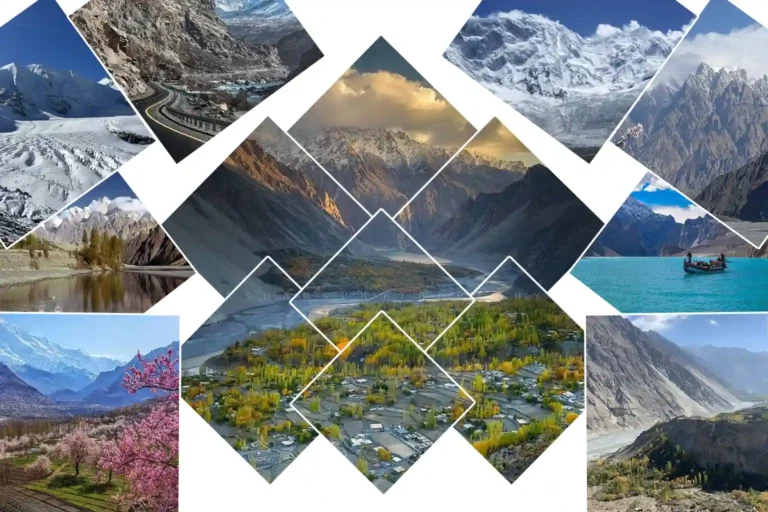
Gojal Valley begins where the Karakoram Highway climbs north of Gilgit and the mountains close tight above the Hunza River. The road threads the gorge, then opens into the broad terraces of upper Hunza, where villages cluster on the higher ground. This is the start of Pakistan’s high northern frontier.
Not far in, the valley fills with the turquoise of Attabad Lake, held behind a landslide that reshaped the valley in 2010. Beyond it, the jagged Passu Cones rise above the road, and glaciers spill down almost to the highway. Few valleys put so much landscape so close at hand.
Gojal is the northernmost reach of Hunza, settled by the Wakhi and shaped by the road that runs through it. Gulmit, Passu, and Sost string along the highway, while the route climbs toward the Khunjerab Pass and the Chinese border. It is a valley defined by movement as much as by stone.
That sense of climbing is the heart of the valley. Gojal rises steadily north: from orchards and lakes to glaciers, high pastures, and the bare ground of the pass. It is both a place to linger and a road to the border, and the further you go, the higher and wilder it becomes.
| Gojal Valley | At a Glance |
| Province | Gilgit-Baltistan |
| Region | Hunza District (Gojal tehsil, upper Hunza) |
| Main bases | Gulmit, Passu, Sost |
| Nearest city | Gilgit (around 100 km) |
| Nearest airport | Gilgit Airport |
| Defining features | Attabad Lake, the Passu Cones, the Khunjerab Pass |
| Valley type | High mountain valley and frontier corridor |
| Elevation | Settlements ~2,400 to 2,800 m; Khunjerab Pass ~4,693 m |
| Ideal duration | 3 to 5 days |
| Difficulty | Easy to moderate |
| Best months | June to September |
| Open season | May to October (Khunjerab Pass usually May to November) |
| Known for | Glaciers, turquoise lakes, Wakhi culture, the road to China |
Where is Gojal Valley? Location and Geography
Gojal lies in the far north of Gilgit-Baltistan, forming the upper part of Hunza where the valley climbs toward the Chinese border. It is the largest and highest tehsil of Hunza, strung along the Hunza River and the Karakoram Highway. Settlements sit between roughly 2,400 and 2,800 metres, rising to the Khunjerab Pass at around 4,693 metres.
The approach is by road from Gilgit, north along the Karakoram Highway and through the Attabad tunnels that bypass the lake. Gulmit, the tehsil headquarters, sits among terraces above the river, with Passu and Sost strung further north toward the pass. Side valleys, including remote Shimshal, branch off toward glaciers and high pastures.
- Province and region: Gilgit-Baltistan, upper Hunza (Gojal tehsil)
- Elevation: settlements ~2,400 to 2,800 m; Khunjerab Pass ~4,693 m
- Nearest city: Gilgit, around 100 km and roughly three hours by road
- Main settlements: Gulmit, Passu, and Sost, strung along the Karakoram Highway
- River: the Hunza, dammed in 2010 to form Attabad Lake
- To the north: the Khunjerab Pass and the border with China
- Side valleys: Shimshal and others, climbing toward glaciers and pastures
The Shape of Gojal: Lake, Glacier, and the Road to the Pass
Gojal is more than a single town. The valley unfolds in stages as the highway climbs north, each marking a step higher toward the frontier.
- On the lower terraces, around Gulmit and Attabad, orchards and villages sit above the turquoise lake, and the highway runs close to the water. This is the most settled and accessible part of Gojal, and the base for most visits.
- Through the middle valley, around Passu, glaciers spill toward the road and the Passu Cones rise overhead. Side valleys branch toward high pastures and remote settlements, and the landscape turns sharply alpine.
- In the upper reaches, beyond Sost, the road climbs through bare, high country toward the Khunjerab Pass and the Chinese border. Settlement thins to grazing grounds, and the land belongs to the wildlife of Khunjerab National Park.
Important: The Khunjerab Pass is open seasonally, usually from around May to November, and closes with the first heavy snow. The high road is subject to landslides and weather, and the border crossing has its own rules. Always check current conditions and timings before heading for the pass.
History of Gojal Valley
Gojal’s history is bound to its position on the high route north, where people, goods, and livestock have long moved between the valleys of Hunza and the lands beyond the mountains. Settlement balanced access to water, shelter from floods, and the pull of the high pastures. Its story is one of a frontier corridor as much as a home.
1. A Corridor of Trade and Migration
For centuries, Gojal lay on the caravan routes linking Hunza to Central Asia, over high passes that only opened in summer. The valley was both a route and a refuge, its villages set where water and arable land allowed. The Wakhi communities who settled here came from the Pamir region to the north and west, bringing their own language and customs.
2. The Karakoram Highway
The opening of the Karakoram Highway in the late twentieth century transformed the valley, replacing the old caravan tracks with a paved road to China. It tied Gojal’s markets and villages into a wider network and made the Khunjerab Pass the highest paved border crossing in the world. The highway remains the spine of life in the valley.
3. The Attabad Landslide and the Lake
In January 2010, a massive landslide at Attabad dammed the Hunza River, submerging villages and a long stretch of the highway and forming Attabad Lake. For years, boats carried people and goods across the water where the road had been. The China-built Attabad tunnels, opened in 2015, restored the route and left behind one of the valley’s most striking sights.
Seasonal Character of Gojal Valley

Gojal’s high elevation shapes its seasons sharply. Road access, river volume, the opening of the meadows, and the Khunjerab Pass all shift with the snow line, and the upper valley clears far later than the lower terraces. Summer is the main season, though the best time depends on how high and how far north you intend to go.
Spring in Gojal Valley: March to April
Spring comes slowly to the high valley. Snow melts from the lower terraces first, the orchards around Gulmit blossom, and the highway clears from Gilgit northward. The upper meadows, side valleys, and the Khunjerab Pass stay closed by snow well into the season.
- Temperature: approximately 2 to 15°C on the valley floor
- Access: lower highway opening; upper valley and pass still closed
- Best for: orchard blossom, quiet villages, the lake
- Avoid if: you are set on the high meadows or the pass
Summer in Gojal Valley: May to August
Summer opens the full valley. The highway runs clear to Sost and the Khunjerab Pass, the meadows and side valleys become reachable, and the lake is at its most vivid. Days are pleasant on the valley floor, though the high country stays cold. This is the busiest and most rewarding season.
- Temperature: approximately 12 to 26°C, much colder at altitude
- Access: full valley open, including the pass (from around May)
- Best for: the lake, glaciers, trekking, the road to Khunjerab
- Watch out for: busy weeks in July and August, and high side streams
Autumn in Gojal Valley: September to October
Autumn brings clear air, golden poplars, and a thinning of crowds. The highway stays open, the light sharpens, and the herders begin to descend from the meadows. Nights turn cold quickly, and the first snow can dust the high passes by late October.
- Temperature: approximately 5 to 18°C
- Access: highway open; the pass closing toward late autumn
- Best for: autumn colour, photography, calm travel
- Best month: late September to mid-October for colour
Winter in Gojal Valley: November to February
Winter closes the high country. Snow blocks the upper routes and the Khunjerab Pass, and life draws down to the lower settlements along the highway. Days are short and cold, tourism fades, and the valley takes on a stark, frozen calm.
- Temperature: approximately -15 to 5°C
- Access: pass and upper valley closed; lower highway may stay open
- Best for: snow landscapes and deep quiet (prepared travellers only)
- Not ideal for: first-time visitors or anyone heading high
Quick Pick
For the full Gojal experience, with the highway clear to the Khunjerab Pass and the meadows open, visit between June and September. For golden poplars, clear air, and fewer people, late September to mid-October is the finest window.
Top Places to Visit in Gojal Valley

Gojal does not reveal itself through a single landmark so much as through the climb north along the highway, where each stage brings a new lake, glacier, or peak. The lower terraces hold the famous lake and villages, while the upper road leads to glaciers, the border, and the wildlife of the high country.
Attabad Lake
Attabad Lake fills the valley floor with a startling turquoise, held behind the landslide that dammed the Hunza River in 2010. Boats, jet skis, and lakeside hotels now line a shore that was once the highway, and the Karakoram Highway crosses above it through a series of tunnels. It is the most photographed sight in Gojal and an easy stop on the main road.
- Location: lower Gojal, on the Karakoram Highway
- Elevation: around 2,400 metres
- Best for: boating, photography, lakeside stays
- Season: vivid and accessible from May to October
The Passu Cones and Hussaini Bridge
Near Passu, the jagged spires of Tupopdan, better known as the Passu Cones, rise sharply above the highway. Close by, the long Hussaini Suspension Bridge sways across the Hunza River, one of the most famous rope bridges in the country. Together they make the Passu stretch the most dramatic on the whole route.
- Location: around Passu, central Gojal
- Best for: photography, short walks, the suspension bridge
- Highlights: the Passu Cones, the Hussaini bridge, glacier views
- Season: May to October
Gulmit
Gulmit, the headquarters of Gojal, is a historic Wakhi town set among terraces above the river. Once a summer seat of the Hunza rulers, it holds old houses, a small museum, and a strong sense of local culture. It makes a quieter, more rooted base than the lakeside hotels.
- Location: lower Gojal, above Attabad Lake
- Best for: culture, heritage, a quieter base
- Highlights: old town, museum, terraces and orchards
Sost and the Road to Khunjerab
Sost is the last town in Pakistan on the highway, the customs and immigration point before the border. Beyond it, the road climbs through bare high country to the Khunjerab Pass at around 4,693 metres, the highest paved border crossing in the world. The drive passes through Khunjerab National Park, home to ibex, Marco Polo sheep, and the elusive snow leopard.
- Location: upper Gojal, toward the Chinese border
- Best for: the pass, the national park, high-altitude scenery
- Note: the pass is seasonal and has border rules; check before going
- Season: the pass is usually open May to November
Borith Lake
Borith Lake, a small brackish lake above Gulmit and Passu, sits near the Ghulkin and Passu glaciers. It draws migratory birds in spring and autumn and makes a quiet base for short glacier walks. A simple guesthouse sits on its shore.
- Location: above Gulmit and Passu, central Gojal
- Best for: birdwatching, glacier walks, quiet stays
- Season: spring and autumn for birds; summer for walking
Gojal Viewpoints
Several points along the highway open clear views over the lake, the river, the Passu Cones, and the surrounding ridgelines. Reached by short detours or walks from the road, they are best in clear weather between May and October. Early morning and late afternoon give the strongest light.
- Location: along the Karakoram Highway through Gojal
- Best for: photography, orientation, the big views
- Season: clearest from May to October
Glaciers of Gojal Valley

If any landscape defines Gojal, it is ice. The valley holds some of the most accessible glaciers in Pakistan, several of them spilling almost to the edge of the highway. They feed the river, shape the side valleys, and give the upper valley its raw, high-mountain character.
Passu Glacier
The Passu Glacier descends in a broad white tongue just off the highway near Passu village, framed by the Passu Cones above. A short walk from the road reaches viewpoints over the ice, making it one of the easiest glaciers in the country to see up close. It is at its most striking in clear summer light.
- Location: near Passu, central Gojal
- Access: short walk from the highway
- Best for: glacier views, short walks, photography
- Season: May to October
Batura Glacier
The Batura Glacier, one of the longest glaciers outside the polar regions, runs roughly fifty-seven kilometres through the mountains above Passu. Its snout lies a short distance from the highway, while its upper reaches are the preserve of serious trekkers. The Batura is the giant of the valley’s ice.
- Location: above Passu, central Gojal
- Access: snout near the road; upper glacier for trekkers
- Best for: trekking, glacier scenery
- Season: June to September for the higher routes
Ghulkin Glacier
The Ghulkin Glacier lies between Gulmit and Borith Lake, crossed by old paths that link the villages and the lake. Its meltwater feeds Borith and the fields below, and walking trails skirt its edge. It is a quieter glacier, well suited to a half-day walk.
- Location: between Gulmit and Borith Lake
- Access: walking trails from Gulmit or Borith
- Best for: glacier walks, reaching Borith Lake
- Season: May to October
Mountains and the Khunjerab Frontier

Gojal is ringed by the high peaks of the Batura Muztagh, a corner of the Karakoram where several summits rise above seven thousand metres. The mountains define the valley’s skyline and feed its glaciers, while the highway climbs between them toward the border. This is the high frontier where Pakistan meets China.
The most famous of these peaks are not the highest but the most striking: the Passu Cones, whose jagged spires draw the eye from the road. Behind them rise true giants like Batura Sar and Shispare, serious mountaineering objectives reached only by long expeditions.
| Peak | Elevation | Notable for |
| Batura Sar | 7,795 m | Highest of the Batura Muztagh, above the Batura Glacier |
| Shispare | 7,611 m | A steep, much-admired summit near Passu |
| Passu Sar | 7,478 m | A high peak above the Passu Glacier |
| Tupopdan (Passu Cones) | 6,106 m | The jagged spires that define the Passu skyline |
Beyond the peaks, the highway climbs to the Khunjerab Pass at around 4,693 metres, the highest paved border crossing in the world. The pass and its approaches lie within Khunjerab National Park, home to the snow leopard, Himalayan ibex, and Marco Polo sheep. It is the literal high point of any journey through Gojal.
Meadows and High Pastures of Gojal Valley

Above the terraces and glaciers, the valley opens into high pasture and grassland shelves. These upper meadows feel remote and exposed, framed by ice and bare ridgelines, and they come alive in the short summer when herders bring their livestock up. They are the green breaks in a largely stony landscape.
The Pastures Above Passu and Gulmit
Grassy shelves climb above the main villages, reached by jeep track or footpath as the cultivated ground gives way to open grazing. The meadows offer wide views back over the lake, the river, and the Passu Cones. Access is best from June to September, once the snow has cleared.
- Location: above the main villages of central Gojal
- Access: jeep track or footpath
- Best for: day trekking, grazing-ground scenery, alpine air
- Season: June to September
Shimshal and the Remote Valleys
The remote Shimshal valley branches east from the highway near Passu, reached by a rough mountain road built by the villagers themselves. The highest settlement in Hunza, it is famous for its mountaineers and its vast high pastures. It is a serious side trip, well beyond the reach of a casual visit.
- Location: side valley east of the highway, near Passu
- Access: rough jeep road; a full side trip
- Best for: remote trekking, mountain culture, high pastures
- Season: high summer
Rivers of Gojal Valley

Water shapes Gojal at every turn, from the glaciers above to the river that runs through its heart. The Hunza River gathers the meltwater of the upper valleys and carries it south, and it was the river’s damming that created the valley’s famous lake. It is the thread that ties ice, terrace, and settlement together.
The Hunza River
The Hunza River runs the length of the valley, fed by the glaciers and snowfields of the Karakoram and the side valleys of Gojal. Cold and grey with glacial silt, it flows south toward central Hunza and eventually the Gilgit and Indus river. Since 2010, its course through lower Gojal has been held back as Attabad Lake.
- Character: cold, fast, glacier-fed, silt-grey
- Note: dammed at Attabad in 2010 to form the lake
- Best viewed from: the highway and the Hussaini bridge
The Glacial Side Streams
From the side valleys, glacier-fed streams cut down to join the Hunza, running strongest through the warm months. They feed the irrigation channels that water the orchards and fields, and several must be crossed on the routes to the upper meadows. They run highest and fastest in late spring and early summer.
- Source: the glaciers and snowfields of the side valleys
- Best viewed from: the side tracks toward the meadows
- Note: cross glacial streams early in the day, when levels are lowest
Things to Do in Gojal Valley

Gojal offers a wide range, from easy lakeside days and village culture to glaciers, high pastures, and the road to the border. Within a short distance the experience shifts from a boat on Attabad Lake to a glacier walk or a drive toward Khunjerab. It rewards both the relaxed traveller and those drawn to the high country.
Boating on Attabad Lake
A boat ride on Attabad Lake is the signature experience of lower Gojal, gliding across water of an almost unreal turquoise. Options run from shared boats to private hires and jet skis, with lakeside cafes and hotels along the shore. Early morning is calmest and best for photography.
- Location: lower Gojal, on the Karakoram Highway
- Best for: boating, photography, lakeside stays
- Season: May to October
Walking to the Glaciers
The glaciers near Passu and Gulmit are among the easiest to reach in Pakistan, with short walks from the road to the Passu and Ghulkin ice. Trails range from a quick viewpoint stroll to longer routes toward Borith Lake and the upper glacier. A guide is worth having on the ice itself.
- Location: around Passu and Gulmit
- Best for: glacier views, short and half-day walks
- Difficulty: easy to moderate
- Season: May to October
Crossing the Hussaini Suspension Bridge
The Hussaini bridge, a long, swaying span of planks and cable over the Hunza River, is one of the most famous and nerve-testing crossings in the country. Even a few steps out give a real sense of the river below and the mountains around. It sits a short distance off the highway near Passu.
- Location: near Hussaini and Passu
- Best for: a memorable crossing, photography
- Note: the bridge is rickety; cross with care
- Season: May to October
Driving to the Khunjerab Pass
The drive to the Khunjerab Pass is the high point of any trip through Gojal, climbing from Sost through Khunjerab National Park to the Chinese border. The road passes ibex and marmot country, and the pass itself stands at around 4,693 metres. Go prepared for cold, thin air, and changing weather.
- Location: upper Gojal, from Sost to the border
- Best for: high-altitude scenery, the national park, the border
- Note: the pass is seasonal; check timings and border rules
- Season: usually open May to November
Trekking and Side Valleys
Above the villages, jeep tracks and footpaths climb toward the high meadows, the glaciers, and remote valleys such as Shimshal. Routes range from easy day walks to serious multi-day treks. The further you go, the more remote and committed the terrain becomes.
- Top routes: the high pastures, Borith and the glaciers, Shimshal
- Difficulty: easy day walks to serious treks
- Best season: June to September
- Tip: a local guide is worth arranging for the higher routes
Photography Along the Highway
Gojal is one of the most photogenic stretches of the Karakoram Highway, with the lake, the Passu Cones, the glaciers, and the high passes all close to the road. The light shifts quickly between the valley walls, and early and late hours are best. Autumn adds the gold of the poplars to the scene.
- Best spots: Attabad Lake, the Passu Cones, the glaciers, the viewpoints
- Best light: early morning and late afternoon
- Best season: summer for ice and water, autumn for colour
- Tip: carry spare batteries, as the cold drains them fast
Where to Stay in Gojal Valley
Where you stay in Gojal depends on whether you want a lakeside base, a village rooted in Wakhi culture, or a stop on the road north. Most visitors base themselves around Attabad Lake, Gulmit, or Passu, where accommodation and supplies are reliable. Further north and higher up, facilities thin toward Sost and the pass.
Around Attabad Lake
The shore of Attabad Lake now holds the valley’s most prominent hotels, from comfortable lakeside resorts to simpler guesthouses. They offer direct access to boating and some of the best views in Gojal. They book up fast in the summer season, so reserve ahead.
- Options: lakeside hotels and guesthouses
- Best for: lake views, boating, comfort
- Booking: reserve early in summer
Gulmit and Passu
Gulmit and Passu offer guesthouses and small hotels with a stronger sense of local life, set among terraces and close to the glaciers. They make quieter, more rooted bases than the lakeside, and many are run by Wakhi families. Meals are simple, local, and generous.
- Options: guesthouses and small family-run hotels
- Best for: culture, glaciers, a quieter base
- Payment: cash is useful; cards are rare
Sost and the Upper Valley
Sost, the last town before the border, has basic hotels and lodges serving travellers heading to or from China. Beyond it, accommodation gives way to camping and a few simple stops. The upper valley is best treated as a day trip from a base further south.
- Options: basic hotels and lodges in Sost; camping higher up
- Best for: an overnight before or after the pass
- Note: stock up on supplies before heading higher
Practical Travel Information
A few practical details make a journey into Gojal smoother. Conditions change quickly with altitude and season, and the upper valley and the pass need more planning than the lakeside terraces.
Entry and Permits
- Pakistani nationals: no permit required for Gojal Valley itself
- Foreign nationals: no permit for the main valley, but check current rules for the Khunjerab Pass and any restricted side valleys with Gilgit-Baltistan authorities
- Border: crossing into China at Khunjerab requires a visa and is not a casual day trip; the pass can be visited up to the border on the Pakistani side
- ID: carry your CNIC or passport for checkpoints
Getting There
- Nearest city: Gilgit, around 100 km and roughly three hours by road to Gulmit
- By air: Gilgit Airport, with flights from Islamabad, is the nearest air link
- By road: the Karakoram Highway runs the length of the valley, through the Attabad tunnels
- Within the valley: local jeeps and vans for villages, side valleys, and the upper meadows
Mobile Network and Connectivity
- Coverage is reliable in the main villages but fades in the side valleys and the high country
- SCOM generally offers the best reach in this part of Gilgit-Baltistan
- Signal is minimal toward the meadows, Shimshal, and the pass
- Tip: download offline maps before heading north of Gilgit
Food and Local Cuisine
Food in Gojal is simple, local, and shaped by Wakhi cooking, centred on the main villages.
- Villages: breads, dairy, apricots, and local dishes in guesthouses
- Specialities: Wakhi dishes, apricot products, and mountain dairy
- Markets: Gulmit, Passu, and Sost cover basics; imported items are limited
- Upper valley: carry supplies for the meadows, Shimshal, and the pass
What to Pack for Gojal Valley
- Warm layers: nights are cold even in summer, and the pass is freezing
- Sun protection: very strong UV at altitude and on the glaciers
- Footwear: walking shoes for villages, sturdy boots for glaciers and treks
- Cash: limited banking, so bring enough for your whole stay
- Rain and wind protection: weather shifts quickly in the high valley
- Supplies: stock specialist trekking gear in Gilgit before heading up
Travelling Responsibly
Gojal’s glaciers, meadows, lakes, and the wildlife of Khunjerab are fragile, so a little care keeps them intact.
- Carry out all litter, especially plastic, as disposal is limited in the upper valley
- Camp on established sites, not on fresh pasture or fragile riverbanks
- Stay on marked trails in the meadows and on the glaciers
- Keep your distance from wildlife in Khunjerab National Park and never feed animals
- Avoid polluting the lake, river, and streams, which supply downstream settlements
- Buy supplies and crafts from Wakhi village shops to support the local economy
Conclusion
Gojal does not need effort to reveal its character. North of Gilgit, the Karakoram Highway climbs into a valley of turquoise water, jagged spires, and glaciers that reach almost to the road. The villages cluster on the terraces, and the river ties it all together.
However, the valley is more than its famous views. Gojal holds the steady rhythm of Wakhi village life beneath a landscape of ice and high passes. It surfaces in a calm morning on the lake, a short walk onto a glacier, and the long climb toward the bare ground of Khunjerab.
It is a valley that adapts to how you travel it. For some, it is a lakeside pause on the road through Hunza. For others, it is the gateway to glaciers, remote valleys, and the highest border crossing in the world, the last green ground before China.
In the end, Gojal is both a destination and a road. The meeting of river, glacier, lake, and mountain forms a landscape that feels complete in itself, yet always climbs beyond. Rather than asking to impress, the valley simply rises north, and stays with those who take the time to follow it.
Frequently Asked Questions
1. What is the best time to visit Gojal Valley?
The best time to visit Gojal is from June to September, when the Karakoram Highway is clear to the Khunjerab Pass, the meadows are open, and Attabad Lake is at its most vivid. Late September to mid-October adds golden poplars and clearer air with fewer crowds. The pass and upper valley close with the heavy snow from late autumn.
2. How many days do I need for Gojal Valley?
Most travellers spend three to five days in Gojal, enough for Attabad Lake, Passu and the glaciers, Gulmit, and the drive toward Khunjerab. Longer stays suit those trekking to the high meadows or making the side trip to Shimshal. The valley is large, so distances add up.
3. How do I reach Gojal Valley?
Gojal is reached by road from Gilgit, north along the Karakoram Highway through the Attabad tunnels, around 100 kilometres and roughly three hours to Gulmit. Gilgit itself is reached by air from Islamabad via Gilgit Airport, or by the long road up the highway. Local jeeps and vans run between the villages and side valleys.
4. Do I need a permit to visit Gojal Valley?
Pakistani nationals do not need a permit for Gojal Valley itself, and foreign visitors can travel the main valley freely. Crossing into China at the Khunjerab Pass requires a visa and is not a casual day trip, though the pass can be reached on the Pakistani side. Check current rules with Gilgit-Baltistan authorities, especially for restricted side valleys.
5. What is Gojal Valley famous for?
Gojal is famous for Attabad Lake, the Passu Cones, and its accessible glaciers, along with the Karakoram Highway’s climb to the Khunjerab Pass and the Chinese border. It is also known for its Wakhi culture and as the gateway to remote valleys such as Shimshal.
6. Is Gojal Valley suitable for families?
Gojal can work well for families, as the lake, the villages, and the glacier viewpoints are easy to reach and the highway is well maintained. Travel should still be planned around the season and altitude. The pass, Shimshal, and the high meadows need more preparation and care with children or older travellers.
7. Can I visit the Khunjerab Pass?
Yes. The Khunjerab Pass can be visited on the Pakistani side from Sost, usually between around May and November, when it is clear of snow. It stands at roughly 4,693 metres, so go prepared for cold and thin air. Crossing into China requires a visa and the proper border formalities.
8. What activities are possible in Gojal Valley?
Popular activities include boating on Attabad Lake, walking to the Passu and Ghulkin glaciers, crossing the Hussaini suspension bridge, driving to the Khunjerab Pass, and trekking to the high meadows or Shimshal. The valley is also one of the finest stretches for photography along the Karakoram Highway.
