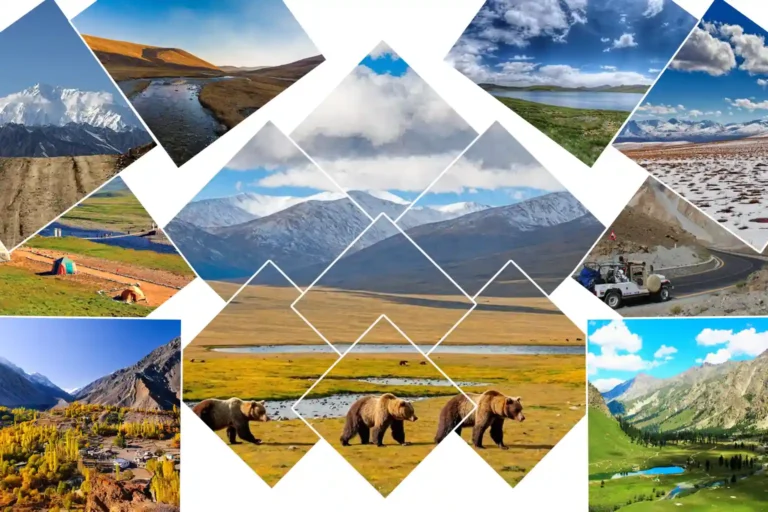
The road from Skardu or Astore crests without warning. One moment the valley walls are close and the slopes are covered in rock and sparse vegetation; the next, the terrain flattens and the plateau opens in every direction. Vehicles seem to shrink against the basin horizon, and the sky, uninterrupted by any ridge or ridgeline, dominates everything above and around.
Sheosar Lake is the first landmark. Its still water holds the blue of the open sky and, on clear mornings, the distant outline of Nanga Parbat to the west. Beyond it, the Deosai basin floor runs flat toward Bara Pani and Kala Pani, broken only by the winding course of the Deosai River and the low shapes of the distant hills. The sense of scale is immediate and does not diminish with familiarity.
Deosai spreads across a high plateau consistently above 4,000 metres, placing it among the highest plateaus accessible by road in Asia. It is a seasonal place. Snow blocks both approach routes from late autumn to late spring. The open window runs from July to late August. Alpine grassland reaches full bloom. Himalayan Brown Bears move across the basin. Bara Pani and Sheosar campsites offer dark night skies.
Most visitors remember the silence more than the scale. It is the exposure. Deosai offers no forest, no shelter, no gradual introduction to altitude. The plateau appears suddenly at full height. Open sky surrounds it. The scene holds until the weather changes.
Deosai Plains at a Glance
| Feature | Detail |
| Location | Skardu and Astore Districts, Gilgit-Baltistan |
| Elevation | Approx. 4,000 m (entire plateau) |
| Nearest Access Town (North) | Skardu |
| Nearest Access Town (West) | Astore |
| Access | Jeep road from Skardu or Astore; no trek required |
| Best Time | Mid-July to late August |
| Peak Bloom | July |
| Main Landmark | Sheosar Lake |
| Main River | Deosai River |
| Defining Wildlife | Himalayan Brown Bear, marmot, migratory birds |
| Permit Required | No (visitor registration may apply at entry points) |
| Mobile Signal | Patchy to absent on the plateau |
| Camping | Designated zones: Sheosar Lake, Bara Pani, Kala Pani |
| Last ATM and Fuel | Skardu town and Astore town |
Where is Deosai Plains? Location and Geography
Deosai Plains lies across the boundary of Skardu and Astore districts in Gilgit-Baltistan, sitting consistently above 4,000 metres. The plateau is accessible by jeep road from two directions: from Skardu to the north via the Satpara Valley and Ali Malik Mar Pass, and from Astore to the west via Chilum village. Sheosar Lake, positioned at the western edge of the plateau near the Skardu approach, serves as the primary orientation landmark for most visitors.
The basin floor is shaped by the Deosai River, which gathers meltwater from the surrounding ridges and winds across the grassland toward the east. Seasonal streams feed the main camping areas at Bara Pani and Kala Pani, and the springs along the plateau edge sustain both the herding communities and the wildflower belt that peaks in July.
- Province: Gilgit-Baltistan
- Districts: Skardu and Astore
- Base Towns: Skardu (northern approach), Astore (western approach)
- Elevation: Consistently 4,000 m and above
- Main Access Roads: Skardu-Deosai Road via Satpara; Astore-Chilum-Deosai Road
- Water Sources: Sheosar Lake, Deosai River, Bara Pani, Kala Pani, seasonal streams
- Nearby Landmarks: Satpara Lake, Satpara Valley, Nanga Parbat viewpoints, Chilum village
- Seasonal Window: Late June (road opens) to mid-October (road closes)
The Shape of Deosai: Approach Road, Plateau Edge, and Open Basin
The landscape of Deosai is best understood as three distinct zones passed through in sequence. Each zone has its own character, and the transition between them defines the experience of arriving at the plateau.
The Approach Valley and Climbing Road
From Skardu, the jeep track follows the Satpara Valley past Satpara Lake before the pavement gives way to gravel and the road begins its exposed climb toward Ali Malik Mar Pass at over 4,000 metres. The valley walls tighten before the pass and then release. From Astore, the route reaches Chilum village before the road transitions to rough track and begins its ascent toward the plateau’s western edge. Both approaches are exposed to wind and rapid weather change, with snow patches possible on the road into early July. The last settlement on either side is the last point for supplies and mobile coverage.
Important: Both jeep roads to Deosai are unpaved above the last settlements and subject to closure from snow or flooding. Check current conditions in Skardu or Astore before departure. Neither route is navigable from late October through June without specialised equipment.
The Plateau Edge and Sheosar Lake
The plateau edge is reached from the Skardu side at Ali Malik Mar Pass and from the Astore side above Chilum. At either point, the terrain levels and the basin opens. Sheosar Lake appears first on the Skardu approach, sitting at the plateau’s western edge with its calm surface reflecting the surrounding grassland and, on clear mornings, the distant silhouette of Nanga Parbat. The lake is the primary stopping point for day visitors and the main camping zone for those spending the first night on the plateau. Water is available from the lake and adjacent streams; it must be filtered or boiled before use.
Quick Pick: For the best early light over Sheosar Lake, set up camp the evening before and walk to the shore before 7 in the morning. The surface is calm and the Nanga Parbat reflection is visible only before the wind picks up across the basin.
The Open Basin Floor: Bara Pani to Kala Pani
Beyond Sheosar, the jeep road continues across the basin floor toward the central plateau. The landscape here is its most complete: short alpine grass stretching to the horizon, the winding course of the Deosai River cutting through the plain, and wildflowers scattered across the grassland during the July peak. Bara Pani and Kala Pani are the main river crossings and camping areas in the basin interior, positioned where the river is wide and clear and where the ground on either bank provides flat, dry surfaces for tents. Weather shifts quickly across this open ground; bright sun can give way to cold cloud and rain within an hour.
A Brief History of Deosai Plains
1. Seasonal Pasture and Herding Tradition
Deosai has served as summer grazing land for herding communities from Baltistan and Astore for generations beyond reliable record. In late spring, snow recedes from the plateau. Families bring livestock up from the valleys. Their routes and stone corrals predate tourism. Sheep, goats, and yaks graze across the basin in July and August. Early autumn cold sends the herders back down. The plateau’s ecology, its grass species, stream patterns, and the distribution of wildflowers, has been shaped by this centuries-old grazing cycle.
2. The National Park and Conservation Era
The creation of Deosai National Park in 1993 was driven principally by the need to protect the Himalayan Brown Bear, whose population had declined sharply due to hunting and habitat pressure. The park covers approximately 3,000 square kilometres of the plateau and its surrounding ridges, giving the bear, marmot, and migratory bird populations legal protection. The Brown Bear population has recovered since the park’s establishment and is estimated at several dozen individuals across the plateau. The grazing tradition continues within the park, with herding families operating alongside the conservation mandate under agreements with the park authority.
3. Tourism and the Jeep Era
Organised visitor access to Deosai developed in the latter decades of the 20th century, following the improvement of jeep roads from both Skardu and Astore. The plateau shifted from a crossing route between valleys to a destination in its own right, with the wildflower bloom and Brown Bear sightings becoming the primary draws. Local communities from Skardu and Astore now operate jeep safaris, manage camping zones, and provide basic services during the July to August window. The economy of the plateau during peak season is built on this community-managed model, and tourism income runs alongside the pastoral economy that has always shaped the land.
Seasons at Deosai Plains

Spring (May to Late June)
The plateau stays mostly inaccessible through late June. Deep snow covers both approach roads and the basin floor. Early wildflowers appear where snow melts. Grass begins to show in patches. Road conditions remain unreliable. Stranding risk stays high. Streams run fast and cold with snowmelt, and night temperatures remain below freezing well into June. Entry is not advisable until both routes are confirmed clear, which rarely occurs before the first week of July.
Summer (Mid-July to Late August)
Mid-July to late August is the only fully open season on Deosai. Both approach roads are passable. The basin floor is snow-free. Wildflowers reach peak bloom across the grassland. Daytime temperatures range from 15 to 20°C. Wind chill can make the open plateau feel much colder. Nights drop below zero even in late July. Sheosar Lake, Bara Pani, and Kala Pani all operate at capacity, wildlife including the Himalayan Brown Bear is most active, and the night skies above the camping zones are at their clearest.
Quick Pick: Mid-July through the first week of August is the optimal window for Deosai. The wildflower bloom is at its densest, both approach roads are reliably open, and wildlife activity is highest before the August heat begins to dry the grass and push the bears to higher ground.
Autumn (September to Mid-October)
September marks the start of the transition. The grass turns from green to gold, wildflowers fade, and the first frosts arrive on the plateau by late September. The approach roads remain open but deteriorate quickly with early autumn storms and freezing nights. Services at the camping zones begin to close, and jeep availability from Skardu and Astore becomes less predictable. By mid-October, both main routes are typically closed by the first heavy snowfall, ending the vehicle access season.
Winter (Late October to June)
Deosai is locked under deep snow from late October through June. All vehicle access stops, the camping zones are uninhabited, and the plateau is accessible only to rare winter expeditions with specialised equipment and full self-sufficiency. Temperatures remain well below freezing, and the wind across the exposed basin is severe. No services or support are available. Winter visits present significant safety risks and are not practical for most travellers.
Top Places in Deosai Plains

1. Sheosar Lake
Sheosar Lake sits at the western edge of the plateau at over 4,000 metres, the first major landmark on the Skardu approach.Its calm, deep water reflects the surrounding grassland. Clear mornings may reveal Nanga Parbat’s outline to the west. Walks are possible along the lakeshore. July wildflowers reach the water’s edge. Grassland stretches beyond the lake toward the horizon. Camping near the lake offers open sky and reliable water access. Early morning, before the day’s jeep traffic arrives, is when the site is quietest and the light is at its best.
- Location: Plateau western edge, Skardu District, Gilgit-Baltistan
- Elevation: 4,000 m+
- Access: Jeep from Skardu (approximately 2.5-3.5 hours); no trek required
- Best For: Camping, morning photography, first night on the plateau
- Season: Late June to mid-October
- Highlights: Calm water at dawn, Nanga Parbat reflection on clear mornings, wildflower lakeshore in July
2. Bara Pani and the Central Basin
Bara Pani is a river crossing and camping area in the interior of the Deosai basin, the main overnight stop for those exploring the plateau beyond Sheosar. The Deosai River runs wide and clear here, and the flat ground on either bank provides some of the best camping surfaces on the plateau. The views from Bara Pani stretch in all directions across the grassland, with no obstruction to the horizon. Wildlife sightings are steadier around Bara Pani. Marmots are common there. Himalayan Brown Bears appear occasionally. Sheosar sees more traffic. Night skies here are excellent, with minimal light from any direction.
- Location: Central Deosai basin, Skardu District
- Elevation: 4,000 m
- Access: Jeep track from Sheosar Lake (approximately 1 hour from lake)
- Best For: Wildlife observation, camping, night skies, basin panoramas
- Season: July to September
- Highlights: Brown Bear sightings possible near water, unobstructed horizon, marmot colonies on nearby slopes
3. Kala Pani
Kala Pani is a secondary river area further into the basin, quieter than Bara Pani and used primarily by those making the full crossing of the plateau or camping for multiple nights. The ground near the water is flat and the views remain open across the grassland. Kala Pani sees fewer visitors in peak season. It feels quieter than the main camping areas. Wildflowers are often denser in the surrounding grass. The richest patches sit away from the jeep track.
- Location: Eastern Deosai basin
- Elevation: 4,000 m
- Access: Jeep track, beyond Bara Pani; full basin crossing route
- Best For: Quieter camping, full plateau crossing, wildflower observation
- Season: July to early September
- Highlights: Less visitor traffic, undisturbed wildflower patches, river water nearby
4. Nanga Parbat Viewpoints Along the Plateau Road
Several points along the plateau road between Sheosar and Bara Pani offer clear sightlines toward Nanga Parbat on cloudless days. The mountain is visible from the plateau at this distance as a white mass above the western horizon, distinct from the rolling ridgelines of the plateau’s own boundary. These viewpoints are informal, marked only by the places where the jeep road runs clear to the west, and are most effective in the early morning before cloud builds above the valley corridors below.
- Location: Along the plateau road, Sheosar to Bara Pani section
- Elevation: 4,000 m+
- Access: Roadside; jeep stops at clear viewpoint sections
- Best For: Long-distance Nanga Parbat views
- Season: July to September (clearest views in early morning)
- Highlights: Nanga Parbat visible on clear days, wide plateau horizon
Wildlife: The Himalayan Brown Bear and the Plateau Ecosystem

Deosai is the primary protected habitat of the Himalayan Brown Bear in Pakistan. The bear population fell sharply before Deosai became a national park in 1993. Protection has helped numbers recover. Bears stay most active in summer. They move across the basin floor and grassland slopes. They search for marmots, roots, and berries. Sightings are never guaranteed. Bara Pani often has steady bear activity. Open ground east of Sheosar is also good in July and August.
Marmots are common across the plateau. Look for them in early morning and late afternoon. Open slopes and river banks are good spots. Migratory birds use Deosai as a staging ground, and raptors are frequently seen riding the thermals above the basin edges. All wildlife should be observed from a safe distance. Food must be secured at night to avoid attracting bears to the camping zones.
Rivers and Water at Deosai Plains
Water is present across the plateau throughout the open season. The Deosai River gathers meltwater from the surrounding ridges and carries it east across the basin floor, crossing the main road at Bara Pani and Kala Pani. Sheosar Lake is fed by springs and seasonal snowmelt and drains into the river system below. Springs near the camps stay reliable from July to August. Main camping zones sit close to these water sources.
Water from all sources on the plateau should be filtered or boiled before drinking. Livestock grazing across the basin means bacterial contamination is possible even in streams that appear clean. During peak season, when campsite density around Sheosar and Bara Pani is high, the risk is greater. A filter or purification tablets should be considered non-optional for any visit.
The Alpine Bloom: July on the Plateau
Deosai’s grasslands look most vivid in July. Alpine wildflowers spread across the basin floor and hills near campsites. Bloom season usually runs from mid-July to late August. Peak colour comes in the final two weeks of July.
Flower density changes across the plateau. Grazing affects many areas. Lightly grazed ground often holds the richest blooms. Undisturbed land away from jeep tracks is best. Slopes above Kala Pani are excellent for walks. The area north of Bara Pani is also rewarding.
Things to Do in Deosai Plains

Jeep Safari Across the Basin Floor
The full plateau crossing by jeep from Sheosar to Kala Pani covers the main character of Deosai in a single day. The route follows the basin floor through the grassland, crosses the Deosai River at Bara Pani and Kala Pani, and traces the ridgeline views at the far end of the plateau. Local drivers from Skardu and Astore operate this route throughout the season and know the river crossing depths and current road conditions.
Hiking the Plateau Slopes and River Banks
Short walks from the camping zones at Sheosar, Bara Pani, or Kala Pani into the surrounding grassland and plateau slopes reward those willing to leave the road. Wildflower density peaks away from tracked ground. Hills above the basin floor give wider grassland views. The road gives narrower views. No technical skill is required; awareness of weather change is the primary safety consideration.
Camping Under Dark Skies
The night skies above Deosai are among the best accessible in Pakistan. No settlement of any size lies within view of the plateau, and the absence of artificial light makes the Milky Way visible from the camping zones on clear nights. Temperatures drop sharply after sunset even in July; a three-season sleeping bag and a windproof outer layer are the minimum. Bear-proof food storage is essential at any campsite on the plateau.
Photography at Sheosar Lake
Sheosar Lake is one of the most scenic stops on the plateau. Clear mornings offer the best reflections. The lake surface is usually calmer before wind rises. July wildflowers often reach the water’s edge.
How to Reach Deosai Plains
Deosai has two approach routes. Both need a 4×4 jeep. Track starts above the last villages. The full journey from Islamabad takes 18 to 22 hours by road to Skardu, with an additional 2.5 to 3.5 hours by jeep to the plateau. Skardu is also reachable by air from Islamabad, weather permitting, which reduces the approach to the jeep stage alone.
Skardu Route (Northern Approach)
The Deosai road from Skardu starts on paved surface through Satpara Valley. It passes Satpara Lake. Gravel begins above the last settlement. Dirt track follows higher up. The climb is steady and exposed, with switchbacks rising to Ali Malik Mar Pass at over 4,000 metres. From the pass, Sheosar Lake and the Deosai basin open below. The road stays rough but usable in the open season. Stream crossings become deeper after rain. Local jeeps are hired in Skardu; no public transport serves the route. The road is typically open from late June to mid-October, with mid-July the most reliable start of the usable window.
Astore Route (Western Approach)
Astore route: paved road to Chilum village. Rough track climbs to the plateau’s western edge. Lower Astore Valley comes first. A steep ascent reaches the Deosai boundary. Chilum checkpoint is the final access control. This route sees less traffic than Skardu route. It gives direct access to the western basin. Full Skardu-to-Astore crossings often use it as the exit. Seasonal closures follow the same pattern as the northern route.
Access Summary
- Starting Point (Northern): Skardu town
- Starting Point (Western): Astore town
- Jeep Section (Skardu): Satpara Valley to Ali Malik Mar Pass; rough track, river crossings
- Jeep Section (Astore): Chilum village to Deosai western entry; unpaved, exposed climb
- Seasonal Window: Late June to mid-October (road); peak access July to August
- Last ATM and Fuel: Skardu town (northern); Astore town (western)
- Transport: No public buses to the plateau; private 4×4 jeeps hired in Skardu or Astore
- Air Access: Skardu Airport served by domestic flights from Islamabad (weather-dependent)
Where to Stay
Plateau Camping Zones
The main accommodation at Deosai is tent camping in designated zones at Sheosar Lake, Bara Pani, and Kala Pani. These areas have been used season after season, with flat, established surfaces and proximity to water sources. No permanent structures operate on the plateau itself. Visitors must be fully self-sufficient: tent, sleeping bag (three-season minimum), cooking equipment, and all food carried from Skardu or Astore. Camping zones open from mid-July to early September. Conditions are usually best in these weeks.
Guesthouses Near Deosai Gate (Skardu Side)
A small number of basic guesthouses operate near the plateau entry on the Skardu approach. These places offer simple rooms and meals. Use them as pre-plateau stays. Use them as post-crossing recovery stops. Quality and availability vary. July peak needs early booking.
Skardu Town and Astore Town
Skardu and Astore offer budget guesthouses, mid-range hotels, ATMs, fuel, supplies, and mobile coverage. Spend one night in either town for acclimatisation. Plan a post-crossing night for rest and logistics.
- Accommodation Type: Tent camping in designated zones; basic guesthouses at plateau entry; full hotel range in Skardu and Astore
- Meals: Self-supplied on the plateau; full food options in Skardu and Astore
- Water: Streams and springs at camping zones; filter or boil before drinking
- Payment: Cash only at all plateau and entry-point facilities; ATMs in Skardu and Astore only
- Mobile Signal: Patchy to absent on the plateau; coverage returns near Skardu and Astore
- Nights: Cold even in July; temperatures below zero possible at any point in the season
Local Culture, Food, and Travel Practicalities
Deosai has no permanent residents. In summer, herding families from Baltistan and Astore bring livestock onto the plateau. They use temporary stone shelters. Sheep, goats, and yaks graze across the basin in July and August. The first autumn cold sends the families back to the valleys. Encounters with herding families on the plateau are common; hospitality is often offered in the form of butter tea or flatbread, and the exchange is best approached with patience and respect for the pastoral work in progress.
Skardu and Astore, the base towns for all Deosai visits, are centers of Balti and Shina culture respectively. Skardu and Astore cover plateau logistics: supplies, fuel, ATMs, guides, and jeep hire. The plateau itself has no food stalls or shops of any kind. Buy all food and supplies in the base towns.
- Languages: Balti and Shina in base towns; Urdu widely understood
- Cash Only: No card or mobile payment at the plateau or at Deosai entry points
- Last ATM: Skardu town and Astore town only
- Supplies: Carry all food, fuel, medications, batteries, and specialised equipment from the base town
- Guides: Local guides available from Skardu and Astore; recommended for wildlife tracking and plateau navigation
- Permits: No permit required; visitor registration may occur at park entry gates
Travel Tips for Deosai Plains
- Jeep Requirement: A 4×4 is mandatory from both Skardu and Astore; hire registered local drivers who know the river crossing depths and current road conditions.
- Acclimatise First: Spend at least one night in Skardu (2,200 m) before ascending to 4,000 m to reduce the risk of altitude sickness on the plateau.
- Timing Your Visit: Plan for mid-July through the first week of August; this is the bloom peak, the most reliable access window, and the highest wildlife activity period.
- Weather Preparedness: Carry layered clothing and waterproof outerwear; weather on the exposed plateau can shift from bright sun to cold rain within the hour.
- Camping Zone Selection: Use designated sites at Sheosar Lake or Bara Pani; these offer the driest ground, reliable water access, and established surfaces.
- Water Treatment: Filter or purify all water from streams and lakes; livestock presence on the plateau makes all surface water a contamination risk.
- Food Storage at Night: Secure all food in bear-proof containers or hung away from the campsite; do not leave food unattended near the tent.
- Mobile signal: Expect no signal once inside the plateau; notify travel contacts before departure and plan for full connectivity loss throughout the stay.
- Supplies: Bring all food beyond what is available in base towns, plus extra batteries, a three-season sleeping bag (minimum), and any required medications.
- Night Temperatures: Even in July, temperatures can drop well below zero; thermal layers are not optional at 4,000 m.
Responsible Travel
- Pack out all waste without exception; the plateau has no disposal infrastructure and the high-altitude grassland ecosystem recovers slowly from disturbance.
- Use designated camping zones; off-track camping damages wildflower cover and contributes to soil erosion on the plateau edge.
- Avoid wildlife. Give Himalayan Brown Bears extra space. Never feed animals. Avoid close-range photography.
- Secure food at night; attracting bears to the camping zones creates danger for subsequent visitors and harms the animals.
- Respect the herding communities and their livestock routes; the seasonal corrals and trails are active pastoral infrastructure, not scenic props.
- Cook on a portable stove; open fires on the plateau damage the grass cover and leave lasting marks on the surface.
- Use biodegradable soap and wash away from streams and lake edges; downstream communities and wildlife depend on the same water sources.
- Hire drivers, guides, and support in Skardu or Astore. Seasonal visitor trade supports the local economy.
- Avoid generators and strong outdoor lighting at the camping zones; the exceptional night sky quality of the plateau depends on the absence of artificial light.
Final Thoughts
Deosai Plains offers a rare kind of arrival: above the treeline, above the valley, at full altitude, under full sky. There is no gradual introduction to the scale of the place. The plateau appears at once and holds that openness for the duration of the visit. Its season is brief, its access dependent on a single narrow window of summer weather and two rough jeep roads. The wildflower bloom, the bear population, and the night skies above the camping zones are all specific to this window, and none of them are enhanced by arriving in haste or leaving in ignorance of what the place requires.
Deosai rewards those who arrive prepared and leave without trace. The plateau’s ecology depends on a long-established balance between grazing and the landscape. Visitors who add their weight carefully and carry their waste out completely fit into that balance. Those who do not, diminish it.
Frequently Asked Questions
1. How do I reach Deosai Plains from Islamabad?
The main route follows the Karakoram Highway north to Chilas. The route runs east along the Indus corridor to Skardu. The total road distance is about 700 kilometres. Travel time is usually 18 to 22 hours. Domestic flights connect Islamabad with Skardu, weather permitting. From Skardu, hire a local 4×4 jeep for the 2.5 to 3.5 hour drive to the plateau via the Satpara Valley and Ali Malik Mar Pass.
2. What is the best month to visit Deosai Plains?
July is the optimal month. The alpine grassland is in full bloom. The jeep road is reliably open. Himalayan Brown Bears stay highly active across the basin. Late July to early August extends the bloom window. Late July to early August reduces the risk of monsoon instability.
3. Do I need a permit to enter Deosai Plains?
No government permit is required. Park staff may collect visitor registration details at the gates. A small summer entry fee may apply. Check current requirements with local contacts in Skardu.
4. Are there reliable water sources on the plateau?
Yes. Sheosar Lake, Bara Pani, Kala Pani, and the Deosai River provide water throughout the open season. Filter or boil all drinking water. Livestock graze across the plateau. This means any stream or lake may carry bacteria. Clear water is not always safe.
5. What camping gear should I bring?
A three-season sleeping bag is the minimum for July nights, which can drop below zero. A tent with good wind resistance is important on the exposed plateau. Bring a portable stove and enough fuel. Carry a water filter or purification tablets. Use a bear-proof food container. Hang dry bags from the jeep overnight.
6. Is Deosai Plains safe to visit with children or older adults?
The altitude rises above 4,000 metres. This creates a real acclimatisation risk for all visitors. Children and older adults face an even higher risk. Spend one night in Skardu at 2,200 metres. Spend one night in Skardu at 2,200 metres. Track headaches, nausea, dizziness, and unusual fatigue on day one. Persistent or worsening symptoms require immediate descent.
7. What is the mobile signal situation?
Mobile signal is unreliable near Skardu and Astore. It usually disappears inside the plateau. Share your travel plan with contacts in advance. Expect no mobile signal across the plateau. Satellite communication devices are an option for those wanting emergency contact capability on the plateau.
8. Are there ATMs or fuel points near Deosai?
Final ATM point: Skardu town. Final fuel points: Skardu town, Astore town. Nothing of this kind is available at the plateau entry, at Tattu, or on the plateau itself. Carry enough cash. Fill the jeep tank in the base town.
