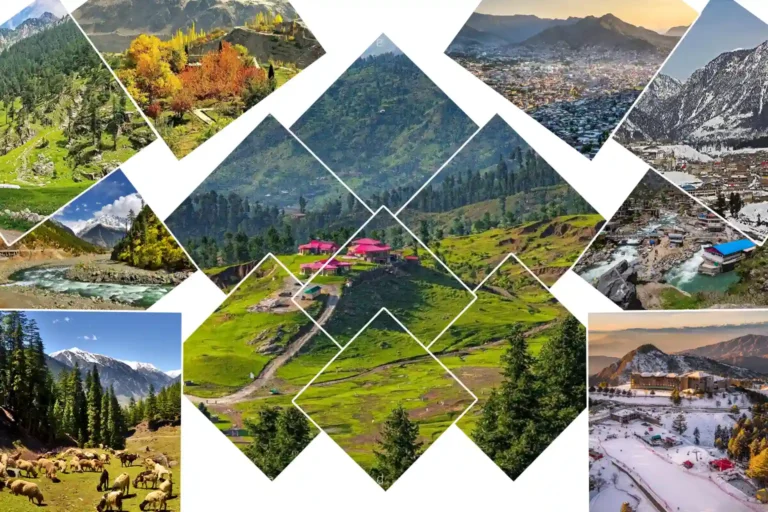
The road north from Islamabad climbs beyond the plains, joining the Swat Expressway as it crosses the Malakand hills and drops into the wide valley floor shaped by the Swat River. Mingora marks the main entry – its markets, bridges, and river crossings anchoring the lower valley.
From Mingora, the mountain road traces the river upstream past orchards, Buddhist archaeological sites, and terraced villages. Side roads climb toward Malam Jabba’s ski slopes while the main route pushes deeper into upper Swat, paved surfaces giving way to rougher mountain tracks past Madyan and Bahrain before the valley rises toward Kalam and its high summer meadows.
Quick Overview
| Field | Details |
| Province | Khyber Pakhtunkhwa |
| District / Region | Swat, Malakand Division |
| Main River | Swat River |
| Main Town / Base | Mingora / Saidu Sharif |
| Elevation Range | 980m – 2,800m |
| Headline Feature | Mingora, Malam Jabba, and upper Swat access |
| Main Access Route | M-1 Motorway & Swat Expressway to Mingora |
| Ideal Duration | 3 – 5 days |
| Best Month | October – clear roads, stable weather, open meadows |
| Permit Required | No general permit |
Where is Swat Valley Located?
Swat Valley sits in northern Khyber Pakhtunkhwa, forming the core of Swat District within the Malakand Division. The valley follows the Swat River, which drains northeast to southwest, shaping both the main travel route and the settlement pattern. Mingora and Saidu Sharif, positioned on the valley floor, act as the administrative and commercial heart of the region.
This position – between high mountains and the settled plains – has shaped Swat’s role as both a historical trade route and a varied travel landscape.
- East: Ridges separate Swat from Shangla and the Indus watershed.
- West: Mountains form the boundary with Dir.
- South: The valley opens toward the plains of Malakand and Mardan.
- North: The valley narrows past Bahrain and climbs toward Kalam’s alpine catchments.
The Journey Through Swat Valley
Past Chakdara, the valley widens and the Swat River becomes the organising line for movement and settlement. Mingora sits at its broadest point, where the road network branches: one route continues north along the river, while others climb toward side valleys and Malam Jabba’s plateau.
North of Mingora, cultivated fields give way to stands of pine and deodar as altitude increases through Madyan and Bahrain. At Bahrain the valley splits, and beyond Kalam the upper valley widens into a higher, cooler basin fed by glacial runoff from tributaries draining off Utror and Gabral.
- Chakdara to Mingora: Wide valley floor, orchards, dense villages, urban core.
- Mingora to Madyan: Terrace villages, fruit fields, the start of pine cover.
- Madyan to Bahrain: Steeper gradients, narrower river road, side-valley junctions.
- Bahrain to Kalam: Rough mountain road, forested slopes, thinner settlement.
- Beyond Kalam: Alpine basin, summer pastures, jeep tracks to Mahodand and Utror.
Things to Do in Swat Valley: Top Places and Experiences
Swat Valley’s appeal sits in the variety packed along a single river road – urban base, ski ridge, river towns, alpine basin, and high meadows, all reachable from one route. The places below form the working spine of any Swat itinerary.
Mingora and Saidu Sharif: Valley Base and Urban Core
Mingora and Saidu Sharif sit at the widest part of Swat Valley, serving as the principal entry point and supply base. The twin towns are the natural starting point for any trip into the upper valley.
- Butkara Stupa – Major Buddhist archaeological site on Mingora’s edge.
- Saidu Stupa and Museum – Combined site for stupa remains and Gandharan artefacts.
- Mingora Bazaar – Central market for supplies, money exchange, and onward transport.
Malam Jabba: Ridge, Ski Slopes, and Upland Forest
Malam Jabba rises east of Mingora, accessible via a winding mountain road. The ridge marks a clear shift from river corridor to upland plateau and is the valley’s main draw for snow sports.
- Winter (Dec – Feb): Skiing, snowboarding, chairlift access.
- Summer (Apr – Sep): Zipline, chairlift rides, cool air, pine forest walks.
- Views: Panoramic outlook back across the main Swat corridor.
Madyan and Bahrain: River Towns and Market Stops
Madyan and Bahrain sit on the river road between Mingora and Kalam, marking the transition from lower valley orchard country to upper Swat’s forested slopes. Both function as practical overnight stops for travellers who prefer not to push straight through to Kalam.
- Madyan Bazaar – Stretched-out market known for shawls, embroidered textiles, and locally made knives.
- Trout restaurants – Riverside spots in both towns, with Madyan more developed.
- Bahrain junction – Where the Daral Khwar joins the Swat River; staging point for Daral and Saidgai side valleys.
Kalam: Upper Valley Hub and Alpine Gateway
Kalam sits at a higher elevation where the valley opens again, surrounded by forest, meadows, and the confluence of tributary streams. It serves as the base for trips into the upper meadows and side valleys.
- Mahodand Lake – Alpine lake reachable by jeep from Kalam in summer.
- Utror and Gabral valleys – Side-valley pastures and trout-fishing streams.
- Kalam Bazaar – Last full supply point before the upper meadows.
Upper Swat Meadows and Viewpoints
The reaches beyond Kalam hold a series of meadows and high pastures, reached by jeep track or footpath in late spring and summer. Roadside viewpoints along the river and on the road to Malam Jabba offer the clearest perspectives on the valley’s structure.
- Best season: Late May to early October for meadow access.
- Best light: Spring and autumn for clear air and contrast.
- Access: Jeep or 4×4 essential for most upper-meadow tracks.
History and Local Background of Swat Valley
Swat Valley’s history reaches back several millennia, with archaeological evidence of settlement from the second millennium BCE. The valley emerged as a centre of Buddhist learning between roughly the 2nd century BCE and the 11th century CE, when it formed part of the ancient region of Uddiyana and sat on a key branch of the trade and pilgrimage routes linking Gandhara with Central Asia.
The introduction of Islam from the 11th century onward gradually displaced Buddhist practice, and the valley later became a princely state under the Wali of Swat before merging into Pakistan in 1969. More recent decades have brought significant disruption and recovery, shaping the current pattern of access.
- Ancient Uddiyana – Buddhist centre; visited by Chinese pilgrims Faxian and Xuanzang.
- Archaeology – Butkara, Saidu Stupa, Jahanabad Buddha, Shakhorai rock carvings.
- Princely State (1915 – 1969) – Wali of Swat era; first schools, hospitals, and roads.
- Late 2000s – Militancy and military operations; civilian administration restored.
- 2010 floods – Major damage to riverbank infrastructure.
- 2019 – Swat Expressway opens, reshaping access from Islamabad.
How to Reach Swat Valley
Most travellers reach Swat Valley by road from Islamabad. The drive is straightforward to Mingora, after which mountain roads take over and conditions become more variable.
By Road
The main approach is from Islamabad via the M-1 Motorway, exiting onto the Swat Expressway near Swabi. The expressway runs to Chakdara, beyond which the route follows the river road through Kabal and into Mingora.
| Route | Distance | Road Type | Approx. Drive Time |
| Islamabad – Mingora | ~240 km | Motorway + Expressway | 4 – 5 hours |
| Mingora – Bahrain | ~60 km | Paved mountain road | ~2 hours |
| Bahrain – Kalam | ~35 km | Partially paved, often rough | 2 – 3 hours |
| Mingora – Malam Jabba | ~50 km | Paved mountain road | 1.5 – 2 hours |
By Air
The nearest airport with regular commercial service is Bacha Khan International in Peshawar, roughly three hours by road from Mingora. Saidu Sharif Airport has hosted limited PIA flights from Islamabad in recent years, though the schedule is inconsistent.
- Peshawar (BKIA) – Most reliable; daily flights, then 3 hours by road.
- Saidu Sharif – Limited PIA service; verify before booking.
- Islamabad (ISB) – Larger hub for international arrivals; drive onward.
By Public Transport and Local Movement
Coach operators run direct services from Islamabad and Rawalpindi to Mingora. From Mingora’s main bus stand, shared vans run to Madyan, Bahrain, and Kalam, with departures thinning out later in the day.
- Long-distance coaches – Daewoo, Faisal Movers, and others from Pir Wadhai or Faizabad to Mingora.
- Shared vans – Mingora to Madyan, Bahrain, and Kalam; depart on a fill-and-go basis.
- Private hire – Most reliable for high meadows and side valleys.
Vehicle Choice and Jeep Access
A standard sedan handles the route up to Bahrain in good weather. Beyond that, ground clearance becomes a real factor, especially after rain or in winter.
- Sedan / hatchback – Fine up to Bahrain in dry conditions.
- SUV / high-clearance – Recommended for Kalam and onward.
- 4×4 jeep – Essential for Mahodand, Utror, Gabral, and any upper-meadow track.
- Local jeep hire – Available in Bahrain and Kalam; daily rates rise sharply in peak summer.
Best Time to Visit Swat Valley

Season shapes travel in Swat Valley. Road access, snow line, river level, and visitor flow all shift with the months. The lower valley remains accessible for most of the year, while upper Swat and high meadows respond to snowmelt, monsoon, and winter closure.
Spring (March – May)
Spring brings snowmelt to the Swat River, swelling its course and feeding orchards along the valley floor. Roads clear below Mingora by March, with upper routes opening gradually as snow recedes.
- March: Lower valley accessible; upper roads still closed.
- April: Orchards in bloom; Madyan and Bahrain fully open.
- May: Kalam accessible; high meadows starting to clear.
Summer (June – August)
By June, the valley is in full movement. All main roads are open, including the route to Kalam and side valleys, and visitor numbers peak around Mingora, Malam Jabba, and upper Swat.
- June: Best month for upper meadows and Mahodand.
- July – August: Monsoon risk; landslides and river surges possible.
- All summer: Peak crowds; book accommodation well ahead.
Autumn (September – November)
Autumn thins the crowds and brings clear air to the valley. Roads remain open, and the river corridor quiets as orchards turn and harvests finish.
- September: Stable weather, fewer visitors.
- October: Best overall month; clear skies, open meadows.
- November: Cold nights; first snow returns to upper passes.
Winter (December – February)
Snow closes many upper routes, but the lower valley and towns like Mingora remain accessible. Malam Jabba draws winter visitors for snow and skiing.
- Mingora and lower valley: Open all winter.
- Malam Jabba: Peak ski season Dec – Feb.
- Kalam and beyond: Often impassable after heavy snowfall.
Quick Pick: October is the best month for clear roads, open meadows, and stable weather across Swat Valley.
Where to Stay in Swat Valley

Accommodation follows the main river corridor, with Mingora carrying the broadest range and options thinning out toward the upper valley. Most visitors establish Mingora as their first base before moving north.
Bookings tighten through summer and during Eid weekends, so secure rooms in advance for June to August travel.
- Mingora / Saidu Sharif – Widest choice; Serena Swat at the upper end, mid-range and budget hotels along Saidu road.
- Madyan – Quieter riverside hotels; good mid-valley base.
- Bahrain – Busier in summer due to side-valley access; mid-range hotels along the river.
- Kalam – Densest cluster of upper-valley hotels; sharp peak-season pricing.
- Malam Jabba – Resort hotel at the slope base; most winter visitors day-trip from Mingora.
- Side valleys (Utror, Gabral, Mahodand) – Basic wooden cabins and summer camps; minimal facilities.
Local Culture, Food, and Travel Practicalities

Swat Valley’s settlement pattern lines the river terraces, with towns, villages, and orchards distributed from Mingora up to Kalam. Bazaars in Mingora and Bahrain are central to daily life and visitor logistics, while livestock move between valley floor and high pastures during grazing months.
Pashto is the main language, with Urdu widely understood in markets and hotels. Trout, river fish, and chapli kebab are the recognisable regional dishes.
- Mobile and Internet – Reliable in Mingora and main towns; weaker in upper valleys.
- Permits – No general permit required for Swat Valley.
- Supplies – Stock up in Mingora or Bahrain before heading to upper Swat or side valleys.
- Packing – Layered clothing, rain protection, and sturdy footwear.
- Local Economy – Agriculture, fruit orchards, livestock, and tourism drive seasonal markets.
- Booking – Reserve accommodation early during peak months and Eid holidays.
Travel Tips for Swat Valley
A few practical points save time and trouble in the valley, particularly around weather, seasonal pressure, and road conditions beyond the paved sections.
- Malam Jabba in Winter – Carry chains and check road conditions before driving up.
- Peak Season Crowds – April to October brings heavy visitor numbers; book well ahead.
- Riverbank Camping – Avoid river terraces during monsoon (July – August) due to flash flood risk.
- Photography – Early mornings give the clearest light; respect privacy in villages and at religious sites.
- Orchard Zones – Spring and late summer slow traffic near picking areas; roadside stalls sell local fruit.
Responsible Travel in Swat Valley
The valley’s combination of river, meadow, and forest is easier to damage than it looks, particularly above the snow line where recovery is slow. A few habits keep the route open and clean for the next traveller.
- Riverbank Waste – Carry out all litter, especially plastic and food packaging.
- Meadow Preservation – Stick to established trails in upper Swat; meadow edges recover slowly.
- Local Supplies – Buy from community-run shops in Mingora, Madyan, and Bahrain.
- Water Use – Use river water sparingly and away from livestock crossings or village intakes.
- Seasonal Access – Respect closures and detours after landslides or heavy rain.
Swat Valley Itinerary: How Long Do You Need?
A practical Swat Valley itinerary runs 3 to 5 days, covering the urban base, ski ridge, river towns, and upper basin. The structure below is the most common working route.
- Day 1: Islamabad to Mingora; afternoon visit to Butkara and Saidu Stupa.
- Day 2: Mingora to Malam Jabba and back, or onward to Madyan.
- Day 3: Madyan – Bahrain – Kalam, settling in the upper valley.
- Day 4: Day trip to Mahodand Lake or Utror / Gabral.
- Day 5: Return to Mingora and onward to Islamabad.
Conclusion
Swat Valley rewards travellers who let the route set the pace. The mountain road follows the river north, and as the valley floor rises and narrows, the landscape does most of the work-orchards thinning into pine forest, market towns giving way to quieter river bends, and eventually the wide alpine basin above Kalam where the river shrinks to a cold, clear stream and the surrounding ridges gather close.
Mingora is a base, not the experience. Malam Jabba is a ridge detour, not the spine. The valley earns its reputation in the stretch beyond Bahrain, where the road runs close to the water and the forest begins to press in from both sides.
Frequently Asked Questions
Q1. What is the best time to visit Swat Valley?
April to October covers the main travel window for most river towns and mountain settlements. October offers the most stable conditions overall. For snow and skiing, December to February is best for Malam Jabba.
Q2. How many days are enough for Swat Valley?
A practical trip length is 3 to 5 days if you focus on Mingora, Malam Jabba, Bahrain, and a day in upper Swat. Add more days for side valleys, meadows, or treks beyond Kalam.
Q3. Do I need a permit for Swat Valley?
No general permit is required for Swat Valley.
Q4. Is Swat Valley suitable for families?
Yes, when plans match the season and route. Lower valley towns, Malam Jabba, and riverside hotels are accessible. Remote routes to high meadows or winter travel require more preparation, especially with children.
Q5. What is the main entry route into Swat Valley?
The main entry is via the M-1 Motorway and Swat Expressway, leading directly to Mingora. From there, the river road continues northward, providing access to Bahrain, Madyan, Malam Jabba, and the upper Swat region.
Q6. Which places define Swat Valley’s travel experience?
Mingora, Malam Jabba, and the upper Swat road toward Kalam form the core of the Swat Valley experience. These areas combine river settlements, Buddhist heritage, ski slopes, and access to mountain landscapes.
